
How nuclear got expensive
Nuclear fission is an incredible source of energy, but can we make it cheap enough to build everywhere?

Nuclear energy feels almost magical. It's incredible that nuclear fission reactions exist that yield millions of times more energy than chemical reactions do. It's miraculous that the trigger needed to cause fission --a free neutron--is itself released multifold by that same reaction, allowing a chain reaction to take place. It's amazing that this strange quirk of nature can be harnessed as a practical and powerful source of energy. There's really nothing like it in all of engineering.
Despite its incredible attributes, nuclear supplies less than 5% of the world's energy and less than 10% of its electricity. Fossil fuels, being cheaper and easier to use, provide the large majority of both. During the dawn of the atomic era in the 1950s and 60s, nuclear held promise as an affordable and nigh limitless source of energy. Dozens of plants were built in the US, some quite cheaply. What happened to that promise? Does that promise still exist? To find an answer, let's look at what happened that made nuclear expensive.
How the West was lost
Nuclear energy famously got more expensive in the United States starting in the 1970s, as depicted in this well-known chart by Lovering. All the large reactors are light water reactors (LWRs), the dominant nuclear reactor technology in the US and around the world. The upward trend in cost has continued with the more recent construction of Vogtle Units 3 and 4, completed in 2024 at an overnight capital cost of ~$15,000/kWe (or about ~$11,000/kWe in 2013 dollars), several times higher than originally estimated.
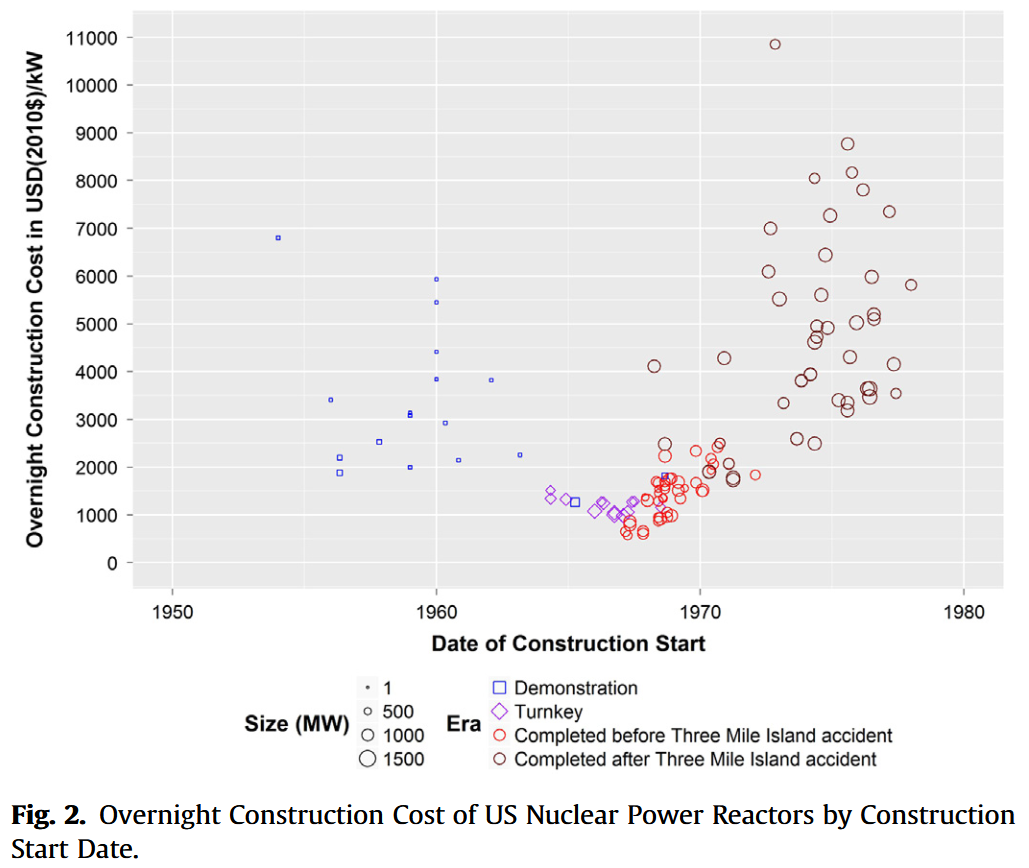
From Lovering, JR; et al., Historical construction costs of global nuclear power reactors, Energy Policy v. 91, April 2016
Everyone has a favorite reason for why nuclear is expensive. Some like to point to excessive nuclear regulations. Some specifically call out the linear no-threshold model of radiation dose response as overstating the health effects of radiation, driving up cost and public fears of radiation hazards. Some think that the choice of technology or design makes the biggest difference. Others say the design doesn't matter much, and it's all about construction productivity and project management. Still others believe that ìlearning curveî effects are what will make nuclear affordable.
Thankfully, there are many excellent accounts of nuclear cost escalation that were written as it was happening, and these paint a more complex picture. In Power Plant Cost Escalation, Komanoff lays out in detail the increases in regulatory standards and resulting changes in plant designs that occurred in this era. These changes were made to meet an increasingly high level of safety as problems and vulnerabilities were found[1]. As a result, nuclear power plants grew larger, structurally stronger, more complex, and yes, more expensive. On the plus side, they also became extremely reliable, with the US fleet regularly achieving capacity factors over 90%, higher than any other form of generation.
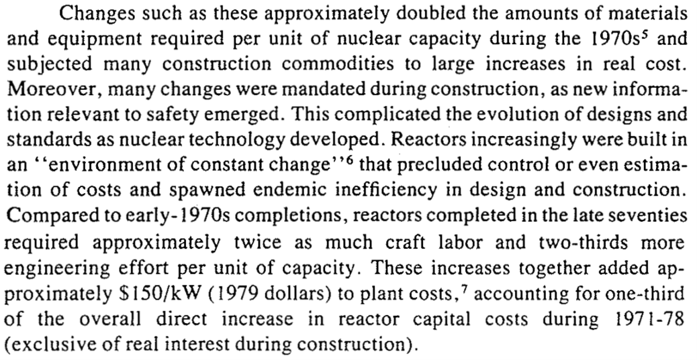
A notable passage from Komanoff's 1981 book.
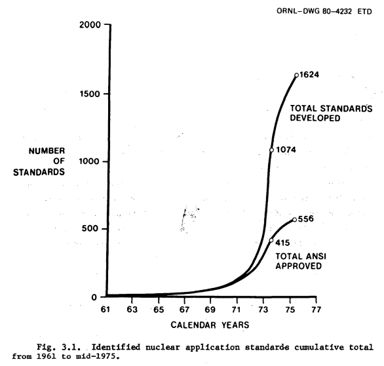
From Oak Ridge National Laboratory and United Engineers and Constructors Inc.: ìPower Plant Capital Investment Cost Estimates: Current Trends and Sensitivity to Economic Parametersî, DOE/NE-0009, October 1979
Making things worse, many of these regulatory changes occurred as plants were in the middle of being built, which threw a huge wrench in the works. Plants that were originally affordable had to have expensive retrofits done. Making things worse still, the whole culture around nuclear construction changed. As described vividly by John H. Crowley in ìUS construction cost rise threatens nuclear optionî, an ìadversarial and legalisticî regulatory environment emerged. Minor defects that would be acceptable in any other industry would trigger expensive rework. Productivity plummeted, time related interest costs shot through the roof, and ìindirect costsî like construction management came to exceed direct costs. To this day, nuclear construction productivity is half that of non-nuclear construction.
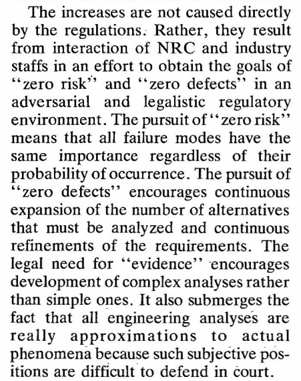
An excerpt from John Crowley's 1982 article
Fast forward to Vogtle Units 3 and 4 in Georgia, and its sister AP1000 LWRs being constructed at VC Summer in South Carolina. Cost escalation at the V.C. Summer plants would cause it to be cancelled partway through construction (there is now a lot of interest in going back and trying to finish construction), utility executives being sent to jail, and a flurry of lawsuits.
A valuable output from the V.C. Summer project was a project assessment report prepared by Bechtel Corporation, which despite being ìstrictly confidentialî was (somewhat amusingly) released by South Carolina's governor anyway. The report describes many self-inflicted wounds: an incomplete and perpetually changing design, lack of a coherent plant model, an unrealistic project schedule, inexperienced module fabricators, and construction labor turnover, among many others.
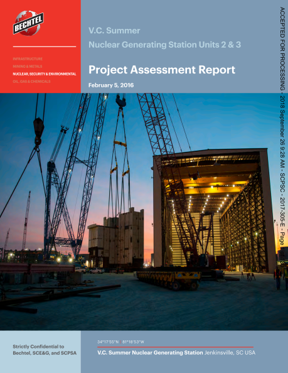
The now-public Bechtel report on the V.C. Summer project
So why is US nuclear expensive? There have been three major reasons:
1. LWR design changes to maintain a high level of safety
2. A legalistic culture of "zero risk" and "zero defects" around nuclear construction
3. And more recently: loss of experience from vendors, suppliers, and constructors
Two of the above reasons have to do with making LWRs extremely safe, so it is worth at least briefly discussing what it is about LWRs that makes this an expensive endeavor.
There are two main culprits: the high pressure of the water cooling system and the thermal limits of the fuel. Water needs to be highly pressurized to raise its boiling point and make it useful for power production: to 150 atmospheres (2200 psi) in pressurized water reactors, or 70 atmospheres (1000 psi) in boiling water reactors. If there is a leak in the coolant circuit, one must fight energetically uphill to push water back in and maintain cooling.
Maintaining cooling is very important because LWR fuel requires it. During operation, a lot of thermal energy is stored in the fuel, with peak fuel centerline temperatures typically exceeding 1500ºC. Meanwhile, zircaloy fuel cladding begins to lose strength, deform, and rupture at temperatures above around 700ºC. Therefore, a momentary loss of cooling can cause fuel pins to rupture, releasing their volatile radionuclides. Fuel is expected to fail in this manner during design basis accidents, and so a strong, leak-tight containment is needed to prevent contaminated steam from reaching the environment.
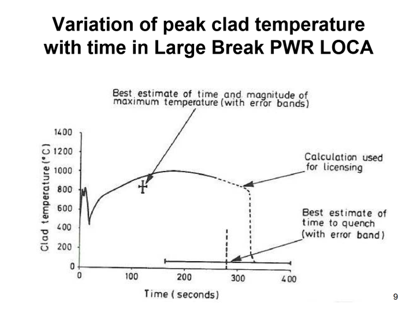
Short-term response to a design basis loss-of-coolant accident
Longer term, cooling needs to be sustained because otherwise, decay heat from the fuel will cause it to heat up and melt, releasing far more radionuclides than in a design basis accident. The Fukushima accident illustrates what happens when energy isn't available to push water into the core and maintain cooling. The major consequences of such events mean that it is important to make them extremely unlikely to occur. The social license for nuclear hinges on it.
To sum up, LWRs have two attributes that warrant a stringent (and expensive) emphasis on safety and near-perfect quality and reliability:
1) The expectation of radionuclide releases from fuel in an accident, which thus requires a containment to contain them; and,
2) The prospect of accidents with major consequences, thus requiring extremely reliable measures to always maintain cooling, even in events like ultra-rare, ultra-strong earthquakes.
A major source of appeal for advanced reactors is the potential to avoid these attributes and the costs associated with them. This will be discussed in an upcoming section on advanced reactors.
Surveying the technology playing field
Now that we know more about how nuclear became expensive, let's take a look at the different types of technologies available and assess their potential for reducing costs.
Large LWRs (e.g. AP1000, ABWR)
Large LWRs have the enormous advantage of being the only fully demonstrated technology, especially AP1000 which has been successfully built and operated in the US. They also work great, with unbeatable records for safety and reliability. They have rightfully earned a lot of attention, including plans to start construction on 10 more AP1000s by 2030.
A large-scale program to build more nuclear plants would be a boon to the industry and help drive down costs. It will help raise the collective experience level of the whole industry: vendors, suppliers, constructors, and regulators alike. Many of the issues plaguing the first US AP1000 builds, such as an incomplete design, can be avoided. This experience building will take time: an industry cannot be resurrected overnight. But the benefits will be long lasting and extend to other nuclear technologies as well.
That being said, large LWRs will still be expensive relative to other forms of generation, with a floor on costs due to the designs themselves, which feature huge quantities of high strength concrete and massive pieces of equipment. This is clearly seen in China, which despite being a paragon of well executed nuclear construction, is still building its large LWRs at ~3x the cost of its coal plants.
Light Water Small Modular Reactors (e.g., BWRX-300, NuScale)
Small modular LWRs use the same basic technology as large LWRs, but at smaller scale: under 300 MWe per reactor instead of 1 GWe or larger. The current interest in small modular reactors started in the late ë00s in response to the escalating costs of nuclear. Since few customers could afford the price tag of large nuclear plants, smaller plants could expand the market for new nuclear. They were touted as "an engineering solution to a financing problem".
Nowadays, some SMR advocates make grander claims: that SMRs will make nuclear energy a lot cheaper thanks to being "modular". With the term "modular", they like to evoke the notion of factory-built reactors that can be shipped nearly intact to a site then assembled with a minimum of effort. The reality is much more modest. Current SMR designs feature concrete structures similar in size to large LWRs, that will still require large construction workforces to build.
Meanwhile, history and common-sense show that economies of scale in nuclear favor larger plants. The AP1000 began as the AP600 before being increased in power to improve its economics. Likewise, the 600 MWe SBWR (ìSimplified Boiling Water Reactorî) design evolved to become the 1600 MWe ESBWR (ìEconomic Simplified Boiling Water Reactorî). Many other designs have gone through similar economics-driven increases in power, including twice for the NuScale SMR, first from 50 MWe to 60 MWe, then from 60 MWe to 77 MWe.
If SMRs aren't modular in the factory-built sense, and economies of scale favor larger plants, then what's so good about them? Well, they remain good for their original purpose, which is to be a product for customers that can't afford larger plants. And these days, when nuclear industry experience is still being rebuilt, SMR projects provide a valuable way to gain that experience with a lot less risk.
Advanced Reactors (e.g. Kairos, X-Energy)
A wide assortment of advanced reactors have been devised, using different coolants and fuels than LWRs. Since choice of coolant has the greatest effect on plant design, advanced reactors are typically categorized by their coolant, with popular options being liquid metal, liquid salt, and helium gas.
Even though most of these technologies were invented and demonstrated many decades ago, they are called ìadvancedî because they bring new capabilities to the table that could eventually lead to them supplementing or replacing LWRs. These capabilities include the ability to breed fuel, operate at higher temperatures, and enhance safety.
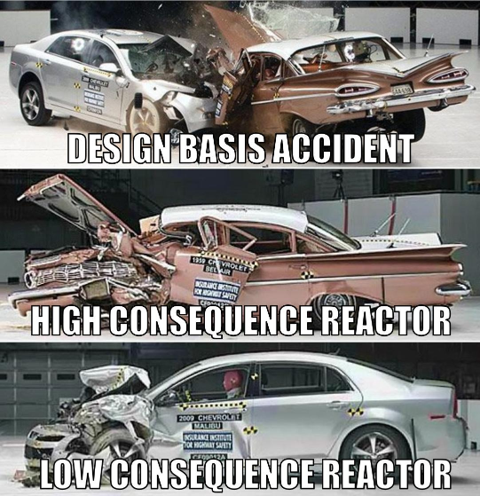
On the safety front, many advanced reactor designs avoid the attributes that make LWR safety a costly challenge: the prospect of fuel failures and the potential for severe accidents. If fuel is not expected to fail and can keep radionuclides contained in accidents, then one can avoid needing a separate containment structure. If long-term cooling can be readily maintained without forcing coolant into a high-pressure circuit, then one can avoid needing a panoply of ultra-reliable safety systems. The term ìinherent safetyî is often used as shorthand for this type of approach.
On top of potentially needing fewer safety systems, advanced reactors could change how nuclear reactors are licensed. Our current licensing regime is predicated on the fact that severe accidents can be extremely bad and must be made exceedingly unlikely, and so everything ìnuclearî must be made to extreme strength and quality standards. New licensing pathways are being deployed (10 CFR Part 53 for advanced reactors and Part 57 for low-consequence reactors), which can ease costly nuclear-specific standards for designs that don't have the same potential for causing a catastrophe.
Originally, advanced reactors were considered more expensive than LWRs, with numerous historical cost estimates and actual reactor builds showing this to be the case. They require additional equipment not found in LWRs, such as additional cooling loops and complex systems for remotely handling fuel. Liquid metal and liquid salt reactors require systems to prevent coolant freezing. Gas-cooled reactors have very low power densities, increasing their physical size while limiting their power output. In an LWR, large open pools of water are used as an inexpensive and practical means of shielding and cooling radioactive fuel. Good luck making a similar large open pool full of liquid metal, salt, or helium.
However, since LWRs have gotten steadily more expensive, advanced reactors may now be the cheaper option, since they don't incur the same costs associated with assuring their safety. And don't forget, the original capabilities that made advanced reactors interesting are still valuable today. In particular, being able to breed fuel would allow nuclear energy to be sustainable for many, many millennia. Affordable breeder reactors are likely to be an important component of mankind's long-term energy supply, and are well worth working toward for that reason alone.
Microreactors (e.g. Radiant Nuclear, Valar Atomics)
Microreactors, befitting their name, are much smaller than large reactors, with power levels typically 10 MWe or below. These were originally developed to take the place of expensive, logistically challenging diesel power for off-grid applications: remote communities, mines, and military bases. The US Army developed, built, and ran a variety of what would now be called microreactors as part of the Army Nuclear Power Program from the 1950s to 70s.
Microreactors would be uniquely suited for these specialized smaller applications, but do they have a chance of becoming cheaper per watt than large reactors? Can they be truly factory produced and deployed by the thousands in large microreactor farms?
Short answer: no. Long answer: there are many issues that make the idea exceedingly challenging. The economies of scale that favor large reactors over SMRs become even more pronounced for microreactors. In particular, neutron physics set a fairly large (meter-scale) minimum size for making a core critical and for radiation shielding, irrespective of whether the reactor is one gigawatt or one kilowatt. Therefore, microreactors wind up needing many times more fuels and material inputs per watt than large plants, setting a non-competitive floor on the cost energy. (See for example, this excellent article on microreactor shielding[2].)
What if we don't bother shielding individual microreactors and just gang a whole bunch of them next to each other? You'd end up with a bunch of radioactive microreactors that can't be maintained or refueled. Meanwhile, hundreds of microreactors will have many more parts (and reactor cores) than a single large reactor, requiring much more frequent maintenance and refueling. These challenges are sometimes waved away by invoking a ìcentralized refueling facilityî that takes care of all the hard stuff. This conveniently takes the costs associated with radioactive fuel management and tucks them out of view, while neglecting the enormous challenge of shipping large, highly radioactive objects to this facility.
Even if microreactors aren't going to replace large reactors, they can still play valuable and unique roles. And importantly, they are the fastest, lowest risk way to successfully complete nuclear projects and build up nuclear industry experience.
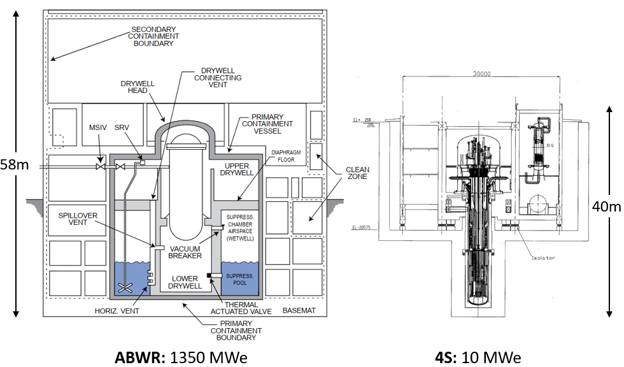
To-scale size comparison of ABWR and 4S reactor buildings, illustrating economies of scale
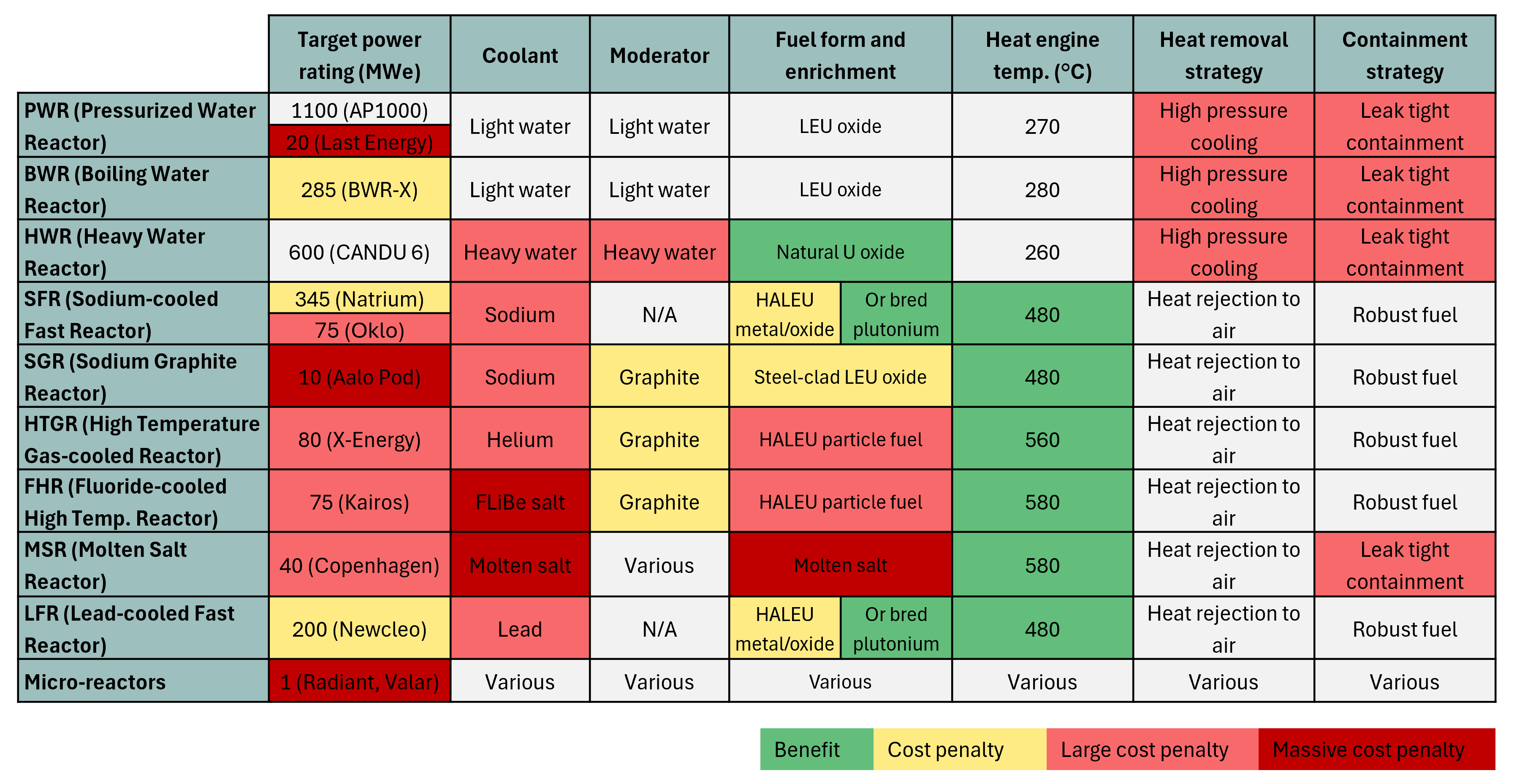
An admittedly subjective summary of the fission technology landscape
So where does this leave us?
To sum up, large LWRs will become cheaper with experience, but will likely remain expensive (but not unaffordably so) compared to other forms of energy. Advanced reactors may end up being somewhat cheaper than LWRs, while bringing worthwhile additional capabilities to bear. And SMRs and microreactors can expand the market for nuclear energy, but are unlikely to lower costs relative to large reactors.
For all of these, building more reactors will strengthen the industry as a whole and lead to better executed projects with lower costs. In addition, public and bipartisan government support for nuclear energy are causing the culture around nuclear regulation to change, potentially addressing an important cause of past cost escalation.
Advanced reactors, SMRs, and microreactors were all originally devised to expand the capabilities of nuclear, not to go head-to-head with large LWRs on cost. If we wanted to come up with a technology that directly addresses the high cost of LWRs, what would that look like?
I believe there is promise in an underexplored area of design space: light water reactors that have the same inherent safety attributes of advanced reactors. Why stick with light water? Light water is in many ways the perfect coolant:
- It is cheap
- It is nontoxic
- It is liquid at room temperature
- We have centuries of experience using it as an industrial working fluid, including decades of experience in nuclear systems
- It has excellent heat capacity and heat transfer properties
- It can be used directly in a steam cycle to generate electricity
- It has excellent nuclear properties, including great moderating power and low neutron absorption
- It has no long-lived activation products
- It shields radiation well while being optically transparent
There have been attempts to design inherently safe LWRs, such as the PIUS (Process Inherent Ultimate Safety) concept developed by ABB Atom in the 1980s, and the PTLWR (Passive Pressure-Tube LWR) concept developed at MIT in the 1990s. Unfortunately, these approaches added significant cost and complexity in their own way. PIUS featured a massive reinforced concrete pressure vessel containing an enormous pressurized water inventory, while PTLWR incorporated a large floodable void space that ballooned reactor size and shielding requirements. However, available design space is large, and it's highly likely that there are unexplored LWR architectures that can achieve inherent safety without a large cost penalty.
With such an LWR, one could solve the issues at the root of why LWRs are challenging and expensive to make safe. If postulated accidents no longer lead to fuel failures, and if decay heat removal is inherently present, then one no longer needs an extensive array of ultra-quality safety and containment systems. We would have more forgiving light-water reactors that avoid many of the reasons that drove up the cost of nuclear in the first place. We can return to nuclear's original promise: low cost and abundant energy for all.
Footnotes
[1] For example, two important areas where such changes occurred were in seismic protection and fire protection requirements.
[2] https://www.linkedin.com/pulse/shielding-microreactors-may-harder-than-you-think-touran-ph-d-p-e--gyssc/