
New frontiers for bright radiation
Powerful infrared lasers are getting extremely cheap. What should we use them for?

How can we leverage recent and surprising cost reductions in diode lasers? Here we look at possible applications in the chemical industry: efficient volumetric heating, targeted pyrolysis, faster ethane cracking and other topics. It’s an area with incredible promise, but as far as we can tell it is still missing its “killer app.”
[This is a heavy one. If you're laser-focused on climate change and could do without so much physics, read Targeted Methane Removal instead]
Brief
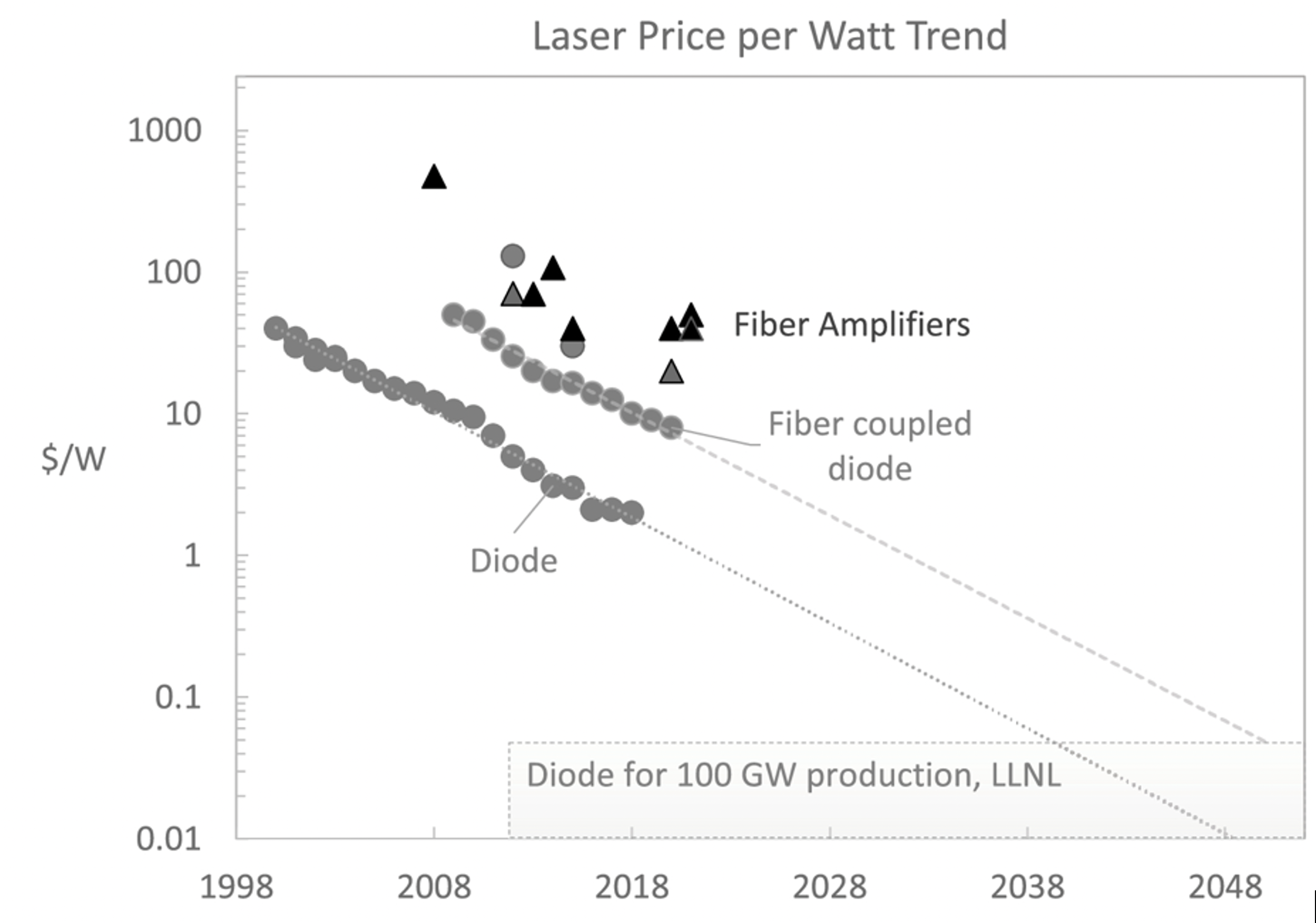
The price of semiconductor laser diodes that are bright, efficient (70%), and long-lasting (10–20 years) is rapidly approaching $1/W. That should change how we think about lasers: the cost of the electricity to drive them could soon dwarf their CapEx, making lasers a viable option for electrified chemical and materials processing. Lasers can deliver unprecedented power intensities volumetrically to a suitably absorbing fluid. They can be rapidly steered and modulated to heat, e.g., a catalytic surface uniformly, or to heat inhomogeneous targets selectively (e.g., to pyrolyze inhomogeneous organic waste into more valuable bio-oils, or to pyrolyze gaseous hydrocarbons into low-cost carbon fibers). Most tantalizing, lasers can also drive non-equilibrium processes, which could make them not just a convenient way to deliver energy to chemical streams but a fundamentally better way to drive important reactions at scale.
In a chemical industry so desperate to electrify that it is willing to throw billions after far-fetched schemes,[1] the size of this laser opportunity is hard to overstate. But it’s also one to evaluate as soberly as possible. The semiconductor lasers farthest down the cost curve operate at 780–980 nm, which constrains the materials that can be processed efficiently. Laser systems could resist coking, but their optics could be vulnerable without special reactor design. Thermal processes can benefit from low-cost heat storage; laser-driven systems cannot. And of course, the economics of electrifying any process that’s now driven thermally may stay dodgy as long as most US grid electrons still come from fossil combustion.
Lasers for chemical processing
Certain varieties of highly efficient near-infrared (NIR) laser diodes appear to be riding a photovoltaic-like cost curve. They’re getting cheap enough that their CapEx could fall well below the cost of the electricity to run them.[2] It’s now possible, for instance, to put a megawatt of continuous-wave (cw) optical power, generated at 70% wall-plug efficiency and tuned to a few-nm-wide molecular absorption band, down a reactor tube several meters long and a few centimeters across, and have the light stay essentially collimated. What does this enable?
First and foremost, the light could be used as heat. NIR light is absorbed by several molecules of practical interest, including hydrocarbons, H2O, H2S, and (comparatively weakly) O2 and CO2. We’ll argue that laser heating could be uniquely enabling for a class of endothermic, uncatalyzed, gas-phase reactions—perhaps enough to justify paying for electricity to do a job, heating, that industry usually does far more cheaply by burning fossil fuels. We’ll illustrate with two example reactions: steam cracking and methane pyrolysis.
Second, and more tantalizingly, the non-equilibrium effects of laser light could open entire new classes of reactions to high-efficiency electrification. Because NIR photons deliver eV-scale energies to specific (typically vibrational) modes of specific molecules, a laser could pump enough energy into one chemical species to drive a particular reaction without driving others (e.g., reverse reactions or side reactions). This is often inefficient. For many reactions of interest, a single NIR photon (1–1.5 eV) carries too little energy to drive the reaction forward with high probability before that energy is lost to the surrounding gas, and absorption cross-sections are typically too small for multiphoton absorption to make practical sense. Non-equilibrium laser schemes may find more use where substantial inefficiency is tolerable, such as triggering chain reactions (we’ll propose ethane cracking as an industrially relevant example) or performing high-value reactions in dilute mixtures (e.g., methane scavenging or hazardous waste cleanup).
A handful of these concepts could be the basis for clean-tech startups—most notably those around methane pyrolysis and steam cracking (both quasi-equilibrium and non-equilibrium). We’ll point out the key technical elements that would need to be derisked. Broadly, the laser approaches here are either equilibrium (all laser energy thermalized in the mix) or non-equilibrium (laser energy partitioned into target molecules in favorable ways). We’ll start with the easier-to-analyze equilibrium cases, then move on to the higher-concept ideas.
Equilibrium: heating with lasers
An oft-cited step toward decarbonizing the chemical industry is to electrify heat, which will make sense in some allegedly forthcoming world of decarbonized grids. To nudge the industry toward electrified heat today, we’d need a good reason—and it’s easy to see why, generally, there isn’t one. Converting fossil fuels to electricity at a power plant, delivering it to a chemical facility over the grid, and converting it back to heat wastes about two-thirds of the heat of combustion. Electricity prices also reflect the CapEx and OpEx of the power plants and the grid, and that’s assuming the grid can even handle the plant’s demand. The net result is that electric heat often costs several times more per unit of energy than direct combustion. It looks like a crummy deal for any low-margin business, even before considering that on today’s fossil-dependent grids it might also be worse for the climate.
Yet in some cases an electrified heating apparatus offers such a critical advantage that industry prefers it. The electric arc furnace in steelmaking is a notable example. It can deliver extremely high power densities to remelt bulk steel scrap while remaining scalable, low-cost, and compatible with intermittent operation. Traditional steel furnaces, by comparison, need to run continuously, are economical only at large scale, and get their heat from carbon combustion distributed through the bulk, which limits how much scrap they can use. Evidently the arc furnace’s specific advantages make up for the higher cost of energy. (Decarbonization startups like Lydian are betting that the same will hold for a wider variety of reactions as electricity prices fall and carbon prices rise.)
By analogy with the arc furnace, laser heating has crucial advantages—principally its high power density—that could give it a toehold in certain industries, especially those that rely on endothermic, gas-phase reactions. Two case studies follow: steam cracking and methane pyrolysis.
Steam cracking
Steam crackers pyrolyze alkanes (e.g., ethane) into olefins (e.g., ethylene, propylene). The reaction initiates at high temperature, but if the temperature is held too long, the olefins themselves start to degrade into products like acetylene and soot. So the best olefin yields come from ramping and quenching the process gas very rapidly: a typical steam cracker ramps its process gas from ~600 °C to ~850 °C over a few hundred milliseconds, then quenches it back to 500–600 °C within another hundred milliseconds.
To achieve such a rapid ramp at high throughput,[3] a steam cracker pushes the process gas at nearly the speed of sound through long (10–100 m), narrow (~10 cm diameter) “cracking coils” held at high temperature (e.g., 1000 °C) by a firebox. A severe drawback is that because the coils must be hotter than the process gas to supply heat quickly, they make excellent nucleation sites for coke. And since coke is a poor thermal conductor, the coils must be run even hotter once coke starts to deposit. Higher temperatures shorten coil life, and eventually it becomes cheaper to shut down the entire cracker and clean out the coke. A shutdown typically costs two days and happens every few weeks to few months, depending on coil length. (Diabolically, shorter coils reduce residence time and improve yield, but they require higher temperatures and therefore coke faster.) Decoking shutdowns are a major operating expense, on top of the capital expense of the massive fireboxes, long coils, and powerful pumps needed to overcome the large flow resistance.
Laser heating could circumvent these issues. A NIR laser might deliver an average intensity[4] of 1 MW/cm2 to the gaseous steam/hydrocarbon mixture, whereas the coil surfaces deliver perhaps 10 W/cm2. The coils radiate in the mid-infrared, while the NIR laser would likely be tuned to water absorption at 950 nm, where optical cross-sections are ~300× lower. So the laser’s advantage in volumetric power delivery is roughly (1 MW ÷ 10 W) ÷ 300, or about 300×. That sizeable margin could let a laser reactor dispense with long, narrow coils and reduce pumping requirements. The reactor walls wouldn’t be hot, so they could be coated with any anti-coking material (whereas coatings on coils must be good thermal conductors), and the reactor tubes could be short and wide. The laser reactor would therefore be far less affected by coke deposition, avoiding decoking losses while still allowing very short residence times for high yield.
An even more stripped-down version of laser-assisted cracking could do away with the steam dilution apparatus entirely, saving further CapEx. One function of the steam[5] is as a diluent: low hydrocarbon partial pressures favor the unimolecular decomposition reactions over unwanted secondary reactions between molecules. Simply lowering the ethane pressure is impractical because the pressure drop across the coils is so large—in some cases as much as 1 atm.[6] The steam’s other function is to combat coking via the water-gas shift reaction. A laser reactor may need neither, since both the pressure drop and the coking are greatly reduced (and coking matters less anyway, as long as it isn’t on the optical window). The laser would then heat the alkanes directly. A practical challenge is that the optical cross-sections of alkanes may be severalfold lower than water’s, which increases the absorption length[7] and raises more concerns about the effects of turbulence on beam quality.
It’s not obvious whether these CapEx and operational advantages could justify the cost of the electricity. Assume heat exchangers bring the process gas up to 600 °C, the lasers handle only the high-temperature step, and single-pass conversion is reasonably high (>50%). Then the laser must deliver ~150 kJ/mol C2H4 (mainly the enthalpy of reaction). At 50% overall wall-plug efficiency, that’s 300 kJ/mol C2H4, or 11 MJ/kg C2H4. At today’s average US industrial electricity price of $0.07/kWh, the electricity would cost $0.21/kg C2H4. Ethane feedstock might add ~$0.25/kg C2H4, for a total of $0.46/kg C2H4 from these inputs alone. Selling the H2 might defray ~$0.10/kg,[8]leaving $0.36/kg C2H4 before CapEx and balance-of-plant OpEx. It’s a little alarming that ethylene sells for $0.40–1.00/kg, since we’re already close to the low end. But before concluding that we can’t compete without a hefty green premium, the true technoeconomics of conventional steam crackers deserve a closer look: these plants may well run at a loss when ethylene sells for $0.40/kg. It’s also worth noting that a decent ethane cracker consumes about 16 MJ of fossil energy per kg of ethylene. Our 11 MJ/kg laser process, plus nontrivial balance-of-plant energy, could easily emit more carbon than a conventional cracker if the electricity comes mainly from fossil fuels.
The laser process looks more appealing if it can run intermittently, taking advantage of low-cost renewables (which would make the decarbonization case strong) or at least cheaper electricity, as the electric arc furnace does. That might be feasible if the design really does save a lot of CapEx in the ways suggested above. We’d likely still use cryogenic separation, which is less suited to intermittent operation, but perhaps we could store the products safely before full separation and run separation in batches, accepting higher electricity costs for that step. Low CapEx would also let us respond to demand: we could idle the facility until ethylene prices recovered to a profitable level. A detailed technoeconomic analysis of a best-case laser reactor would be needed to test these arguments. The likely truth, though, is that steam crackers’ CapEx is low enough that we can’t displace them on CapEx alone. Using scaling data, I estimate ~$1B for a plant producing a million metric tons per year—a few cents per kg amortized over a few decades of operation (closer to 10¢/kg at a typical cost of capital).
Methane pyrolysis
Electrified pyrolysis of methane (or other hydrocarbons) yields blue hydrogen plus carbon-containing species whose identity depends on reaction conditions; valuable pyrolysis co-products include carbon black and acetylene.[9] Lots of startups are onto this—CZero, Molten, Modern Hydrogen, and Monolith are notable examples—with different schemes to heat methane without oxidizing it (some in molten metal, some in plasmas, some via steam reforming followed by the Boudouard reaction). None can survive as a company without either a subsidy or a valuable co-product: pyrolysis yields only 2 H2 per CH4, and on that basis loses to incumbent steam methane reforming, which yields 4 H2 per CH4. Even so, none of these approaches seems particularly well optimized to deliver a valuable carbon co-product.
Carbon black
Carbon black is used mainly to reinforce tires and as a pigment. Most of it is made by the “furnace black” method: liquid hydrocarbons are fed into a natural gas flame, which pyrolyzes them into carbon black particles. Particle size can be tuned through the quench conditions (typically water injection), residence time, or reactor geometry. The method isn’t emissions-friendly, and the product isn’t especially pure, owing to the oxygen present and the liquid feedstocks. But if the heat has to come from a burner, there aren’t many good ways to heat a gaseous feedstock other than injecting it directly into the flame.[10]
More options open up when the heat is delivered electrically. Arc and microwave plasma reactors have delivered high-temperature heat to gaseous feedstocks at high power densities for decades, but only recently has anyone claimed an industrially compelling “plasma black” process. In Monolith’s scheme, one or more hydrogen plasma torches feed hydrogen plasma into a stream of natural gas, which pyrolyzes into more hydrogen and fairly pure carbon black.[11] By tuning the plasma parameters (e.g., hydrogen flow rate, power), Monolith claims it can produce different grades of plasma black (different morphologies, etc.). It further claims that its plasma black is particularly effective at reinforcing tire rubber, and that it can sell both carbon black and hydrogen at prices competitive with today’s dirtier processes.
“Laser black” made from natural gas could be even more appealing. Here a NIR laser tuned to a methane absorption band (e.g., near 890 nm[12]) would deliver heat at very high power density to a continuous stream of natural gas in a simple tubular reactor with optical access. Many experimental knobs would be available: pressure,[13] flow rate, beam geometry and power density,[14] feedstock preheating, hydrogen input, optional quenching schemes, and more—arguably a richer design space than plasma black offers. Since neither the materials science of carbon black nor the chemistry controlling its formation is very well understood, it’s anybody’s guess whether laser black would be more or less valuable than its peers. One reason for optimism: thermal pyrolysis is expected to form acetylene as an intermediate, which then decomposes to carbon black,[15] and the thermal decomposition of acetylene is known to produce a more graphitized, conductive carbon black (“acetylene black”) that is valued by the semiconductor, electronics, and battery industries. The existing market for acetylene black is admittedly small, but the product could see wider use if it were cheaper or could be tailored to other applications (e.g., tires).
The laser process could beat Monolith’s on price thanks to several operational advantages. Because the reactor is so simple, cleaning downtime should be minimal—as long as every optical surface can be kept free of soot (a big if, though careful choice of materials, reactor and flow geometry, and active anti-soot measures could overcome it). Monolith reportedly plans for substantial downtime—as much as a few days every two weeks—to clean reactors and replace plasma electrodes. The laser reactor could also naturally use heat exchangers to cut the energy bill of its fully thermal process.[16]
Acetylene
Acetylene is made by one of three modern processes: the calcium carbide process, arc discharge in hydrocarbons, or as a byproduct of steam cracking. Its use as a chemical intermediate has declined since the 1960s as lower olefins from steam cracking became more available, but acetylene torches remain useful for their unsurpassed flame temperature. A key drawback of acetylene is that it’s explosive, which makes it expensive to store and transport. If it could be made in a distributed fashion from electricity and ubiquitous natural gas—avoiding long-distance transport and easing the storage problem—it could likely find more commercial use. (Whether the co-produced blue hydrogen would be useful in this scenario, and whether we really want the world using more acetylene, are valid but separate questions that I won’t try to answer here.)
A laser pyrolysis reactor like the one imagined for carbon black could also make acetylene. Thermal pyrolysis of natural gas, which proceeds above 1000 °C, is thought to produce first ethane, then (rapidly) ethylene, then acetylene. By quenching the process gas rapidly—for instance by directly injecting more feedstock or an inert gas, at the cost of additional downstream processing—it’s conceivable to get high acetylene yields, likely along with some solid carbon.[17]
As with carbon black, plasma would be the competition. Plasma has been used to make acetylene from hydrocarbons since the 1940s, and several industrial facilities (tens of kilotons per year) have been built using electric arc discharges. They achieve 30–45% energy efficiency in converting feedstock to acetylene, with ~80% selectivity for acetylene over other hydrocarbons in the output stream. A recent startup, Transform Materials, which seems similarly motivated to provide distributed acetylene production from natural gas, claims to have built a modular microwave plasma reactor for the purpose. Its claimed energy efficiency is in line with the old literature (~40%), with slightly higher acetylene selectivity (90–95%).
It isn’t clear to me a priori whether laser or microwave plasma pyrolysis would work better for distributed acetylene production. The laser process probably wouldn’t be more efficient: the laser’s own wall-plug efficiency is probably 70–80% at very best, whereas Transform claims its 100 kW magnetrons are 90% efficient and deliver energy to the plasma with very little loss. The laser might have some operational advantages, depending on how problematic soot on the window turns out to be. The plasma reactor must stop for a few minutes every hour and switch process gas to burn off soot in its narrow reactor tube, whereas the laser process could be less prone to clogging and fouling thanks to a much wider reactor tube and a much lower reaction temperature (Transform’s gas temperature is 3000 °C). The laser process might also save a bit of energy and CapEx by running at higher pressure, whereas Transform’s plasma must run at about 0.1 atm, as is typical for plasma processes. Then again, lower pressure might favor acetylene production (advantage: plasma).
We consider the case for distributed acetylene production by any method somewhat suspect, and the case for lasers improving on plasma here looks shaky. Still, it’s an example of where an electrified solution could make sense because an endothermic, gas-phase reaction is involved.
Non-equilibrium
Although lasers could be interesting for particular heating applications, it’s the non-equilibrium side of laser chemistry that has received the most attention. The sections below look at several of these ideas and ask whether any of them connect to commercial utility. I’ll skip the well-trodden areas of photochemistry and photocatalysis, which in any case need more energetic photons than our low-cost NIR diode lasers provide.
The holy grail: selective bond rupture
A longstanding goal of laser chemistry is to break specific bonds in specific molecules within a mixture, selectively triggering reactions.[18] The idea is simple: since infrared light couples into specific vibrational modes, it should be possible to excite, say, a C–H stretch to the point of dissociation while leaving other bonds intact. But the concept has so far proven of limited practical relevance. The trouble traces largely to anharmonic coupling between the vibrational oscillators of a polyatomic molecule, which rapidly redistributes energy among the modes—often in less than a picosecond, and likely even faster near dissociation. Under such conditions, only ultrashort, ultra-high-power lasers could even in theory pump dissociation-level energy into a single mode. Anharmonicity also means that the energy gaps between an oscillator’s successive vibrational levels aren’t constant; they change with the oscillator’s quantum number. As a bond absorbs more vibrational energy, its absorption lines therefore shift, which makes it hard to “climb the quantum ladder” to dissociation with photons in a fixed, narrow frequency range.
The next closest thing: vibrational catalysis
A more tractable version of these non-equilibrium ideas—which I’ll loosely call “vibrational catalysis,” in what I think is a slight abuse of the term—is to pump energy into all the vibrational modes of selected molecular species and hope this helps overcome the activation barrier of a reaction of interest. Though less powerful than the holy grail above, vibrational catalysis could still beat a fully thermal process in some cases. Take the water molecule, which has 3 translational, 3 rotational, and 3 vibrational modes. Say a reaction is known to proceed from a particular activated configuration of water, reached when at least some minimum energy Ea is partitioned into certain vibrational modes. Now consider two baths of water molecules with the same average energy ⟨E⟩ per molecule. In the first, a thermal distribution, that energy is spread across all 9 modes; in the second, held at an elevated vibrational temperature, it is confined to the 3 vibrational modes. A molecule drawn at random from the thermal bath has a minuscule chance of being in the activated configuration, which corresponds to a tiny subset of the possible microstates. A molecule drawn from the vibrational bath has an orders-of-magnitude larger chance, because its state space is so much smaller. In this way, vibrational catalysis could give a much higher forward reaction rate than a thermal process for the same energy input.[19] Practically, that could mean better energy efficiency, or the ability to drive reactions that would otherwise demand inaccessible temperatures.[20] Depending on how selective the excitation is, vibrational catalysis might also drive desired forward reactions of certain species without driving reverse or off-target reactions.
The ideas behind vibrational catalysis have been explored using non-thermal plasmas.[21] Under certain plasma conditions, electrical energy (e.g., from microwaves) is thought to go almost exclusively into the vibrational modes of specific molecules. The most notable example is the reaction N2 + O2 → 2 NO, which in a thermal process requires temperatures of several thousand kelvin because of the large (~10 eV) barrier to cracking nitrogen.[22] The energy efficiency of the non-thermal plasma is claimed to be 30% of the thermodynamic limit, with much higher conversion than any thermal process achieves under practical conditions.[23]
A laser-based version of vibrational catalysis has some key advantages over its plasma counterpart. Plasma excitation is rather unselective. In some cases, as with nitrogen/oxygen plasma, electrons can be excited so that most of the delivered energy goes into the vibrational modes of a desired species, but that isn’t possible in general. In some mixtures, conditions that vibrationally excite one reactant cause unintended excitations of another (rotations, electronic excitation, ionization). And the excited electrons will inevitably excite the product species too, potentially driving reverse or off-target reactions. The only way around these problems is to be very selective about which reactions to attempt. Lasers, by contrast, can in principle deliver vibrational energy to reactant species in arbitrary ratios, as long as the molecules have infrared-active modes. With some luck in the absorption spectra, lasers can also avoid, or at least limit, exciting the products.
Despite these considerable advantages, laser-based vibrational catalysis looks like a technical long shot without major advances in laser technology. The basic trouble is that a single NIR photon—the only kind we can currently supply with any reasonable combination of wall-plug efficiency, optical intensity, and capital cost—often doesn’t carry enough energy to overcome an activation barrier. So multiphoton absorption is required, and that is hard to do efficiently.
Take methane as an example. Activation barriers might be ~4 eV, roughly the strength of the C–H bond.[24] Near room temperature, an average methane molecule, with 9 modes at ~25 meV each, carries less than a quarter of an eV. Exciting an average molecule to ~4 eV therefore requires it to absorb three or four NIR photons before the vibrational non-equilibrium dissipates into the bath. Given a vibrational–translational (V-T) relaxation time of 2 µs·atm for methane near room temperature[25] and a practical operating pressure of ~1 atm, we have ~2 µs to get three or four photons into a given molecule. Because of anharmonicity (and multiplicity effects, explained below), a molecule that has absorbed one NIR photon should have quite a different absorption spectrum from an average thermal molecule. At first blush this looks like a feature rather than a bug: the spectral shift distinguishes molecules that have already absorbed a photon, so it could be used to excite only those molecules further. Without it, we’d have to supply all (or most) molecules with 3–4 eV within the V-T relaxation window. Doing that with NIR lasers would quickly blow through various practical limits because of the small optical cross-sections,[26] and even if it worked, we’d be left with a lot of excess energy to dissipate.[27] But even with spectral selectivity, getting the next photons absorbed efficiently won’t be easy. Say we excite only 0.1% of the molecules within one V-T lifetime, sidestepping the intensity problem described in footnote 26. Then the absorption length for the second photon is at least a thousandfold longer.[28] It was already problematically long, at >10 m for 1 atm; I doubt there’s any practical way to fold the optical path enough to reliably get 10 km of propagation through a turbulent mixture.
The moral of the methane example is that multiphoton absorption with NIR light is going to be tremendously inefficient. NIR cross-sections for most other molecules of interest are at most an order of magnitude larger than methane’s—not enough to change the qualitative conclusion. And multiphoton absorption is probably required in most cases: if an activation barrier were only ~1 eV, reaction rates would already be reasonable at fairly low temperatures, and there’d be less reason to turn to non-equilibrium chemistry.
The picture could change somewhat if we could use the mid-infrared (MIR) instead of the near-infrared. MIR absorption cross-sections are five or six orders of magnitude larger, which brings the required optical intensities and absorption lengths into far more reasonable territory. If we could make cheap (~$1/W), efficient (60–80%) lasers at a judiciously chosen set of MIR wavelengths, it would be very interesting to see whether the multiphoton scheme imagined here could be made efficient. Alas, no such lasers exist today, and the approaches being pursued in academia don’t look terribly promising.[29]
Before launching a heroic quest to build the perfect MIR laser, it’s worth acknowledging a general limitation of any vibrational catalysis scheme. Roughly speaking, vibrational catalysis means paying for electricity to do a catalyst’s job. Whether that makes practical sense depends on how expensive the candidate catalyst is, and on how much excess energy must be spent per molecule to push the system over the activation barrier. In many cases—including the famous NO-from-air plasma—the excess amounts to several eV per product molecule, often several times the reaction enthalpy. Unless that excess can be recovered as high-temperature heat, which may not generally be possible, we can expect a big efficiency hit. Add the losses in whatever converts electricity into vibrational energy (a laser, magnetron, or gyrotron), and it’s easy to see why vibrational catalysis might be too expensive for many applications, especially commodity processes.
Vibrational catalysis for chain mechanisms
Vibrational catalysis as imagined above may be crippled by its need for multiphoton absorption and its steep efficiency penalty. But those drawbacks don’t matter in every case. One notable exception, explored here, is using vibrational catalysis to trigger a chain reaction. If the chain is long enough, only a small fraction of the reactant molecules need to be triggered, and the triggering needn’t be efficient.
Let’s revisit ethane cracking as a use case for this non-equilibrium scheme. Ethane pyrolysis is a chain reaction,[30][31] thought to be propagated by ethyl radicals (C2H5) through the unimolecular decomposition C2H5 → C2H4 + H and the abstraction H + C2H6 → H2 + C2H5. These chains are believed to run long, terminating mainly when two ethyl radicals recombine into butane: 2 C2H5 → C4H10. The initiation step is the unimolecular decomposition of ethane into methyl radicals, C2H6 → 2 CH3; the methyl radicals then attack ethane to form ethyl radicals via CH3 + C2H6 → CH4 + C2H5. Splitting ethane into methyl radicals has by far the biggest activation barrier (3.7 eV) of any step in the mechanism.
In typical steam cracking of ethane, the process gas is heated to 500–600 °C in the furnace’s “convection zone,” ramped very rapidly to 800–900 °C in the radiant zone to perform the cracking, then rapidly quenched to 400–600 °C to avoid side reactions such as the formation of acetylene or solid carbon. Arrhenius data[32] suggest that at 600 °C only the initiation step, C2H6 → 2 CH3, is especially slow because of its large activation barrier, with a rate constant of 4 × 10⁻⁵ s−1. The next slowest step, the unimolecular decomposition of C2H5 in the chain, is nine orders of magnitude faster at 600 °C: about 5 × 10⁴ s−1. So a key reason steam crackers need high temperatures is to overcome the 3.7 eV barrier of the initiation step.
What if instead we used vibrational catalysis to trigger the initiation step while holding the gas near 600 °C? If it worked, it could hugely simplify the cracker by eliminating the high-speed flow and the quench and heat-recovery hardware, saving CapEx and energy. Without the high-temperature step, coking might drop sharply—a major operational advantage, as discussed above for quasi-equilibrium laser heating—and suppressing coking might in turn allow the steam circuit to be eliminated entirely (see the steam cracking section).
What follows is a crude feasibility study using basic statistical mechanics, the classical RRKM theory of unimolecular decomposition, and Arrhenius parameters from the literature. The numbers suggest the concept could be viable—but I should emphasize that the analysis is sketchy. When ethane at 600 °C is irradiated with 1.4 eV light (880 nm), about 1 in 100 photons could trigger a chain reaction. By tuning the optical intensity appropriately, the chain length can be made ~100, so that the energy of the photons that don’t trigger chains supplies the heat of reaction (which is very close to the photon energy) rather than raising the temperature of the gas. The process could run at a practically useful overall reaction rate (C2H6 → H2 + C2H4) of around 0.25 s−1. One challenge is the rather long absorption length, which could be ~100 m in ethane at 1 atm (I don’t have exact data). But it may be possible to build suitable reactors.
Gory details
Classical RRKM theory[33] is an easy (if possibly incorrect) starting point. It describes the rate of unimolecular decomposition by assuming that for the reaction to occur, one specific vibrational oscillator must carry the entire activation energy. Working through the combinatorics (balls distributed among s energy bins) shows that this condition is met a fraction ((E − E0)/E)s−1 of the time, where E is the total energy stored in s modes and E0 is the activation energy. So the reaction rate is vanishingly small if the molecule has only just enough energy to reach the activation energy—which makes sense, since there are then vanishingly few ways to distribute the energy that put all of it in the right oscillator. The more modes, the more energy is needed for a reasonable probability.
In the high-pressure limit, the overall rate can be shown to take the Arrhenius form k = ν e−E0/kBT, where ν is the attempt frequency. Experimental fits for ν and s often find that ν is a few orders of magnitude larger than one might expect (e.g., a thousand times the thermal frequency) and that s is about half what you’d expect from counting vibrational modes. For ethane near 600 °C, Laidler[31]suggests s = 9, E0 = 3.7 eV, and ν = 1017 s−1.
What is the minimum energy an ethane molecule must have so that, when hit by a 1.4 eV photon, it decays to 2 CH3 with near-unity probability? Ethane’s V-T relaxation time is short:[25] ~20 ns near 600 °C and 1 atm (we’ll assume this pressure for now). Naively applying RRKM, a molecule with energy E > E0 reacts at a rate ν((E − E0)/E)s−1. (This formula, with its unphysical ν, may well describe ensemble behavior, but it strikes me as misapplied to a single molecule. I haven’t thought of a better alternative, so I’ll forge ahead with this estimate, keeping that major caveat in mind.) If we require this rate to exceed the relaxation rate by more than a factor of ten—i.e., ν((E − E0)/E)s−1 > 1 GHz—we need E > 4.1 eV. This naive assessment suggests that a molecule with energy E* = 4.1 − 1.4 = 2.7 eV would likely convert to 2 CH3 when struck by a 1.4 eV photon.
Within a crude classical model, the fraction of molecules at 600 °C with E > E* = 2.7 eV is:

The choice of s matters, and it isn’t obvious which value best mimics the real gas once quantum effects are considered. With s = 3N = 24, an optimistic case,[34] we find P>(E*) = 0.01; a more pessimistic choice[35] might be s = 13, giving P>(E*) = 3 × 10⁻⁶. I’ll use the optimistic case below. If only 1% of the 1.4 eV photons supplied trigger a chain reaction and we want to hold the temperature constant, the chain length must be ~100 (i.e., each ethane molecule split into 2 CH3 leads ~100 others to convert to C2H4); this works because the enthalpy of reaction is so close to the photon energy. With a rate constant of 5 × 10⁴ s−1 for the chain propagation step at 600 °C, we therefore need a chain termination rate of 5 × 10² s−1. Chain termination—the bimolecular combination of ethyl radicals into butane—proceeds at a rate of ~108 s−1 atm−1 according to the literature.[31][36] At a total pressure of 1 atm, we therefore need an ethyl radical volume fraction of (5 × 10² s−1) / (108s−1) = 5 × 10⁻⁶. Maintaining that fraction gives a net conversion rate (C2H6 → H2 + C2H4) of 5 × 10−6 × 5 × 104 s−1 = 0.25 s−1, which seems practical.
One major experimental challenge is the absorption length in ethane. We don’t yet know the absorption cross-sections exactly. Above I used a rough figure of 10−23 cm2 for NIR cross-sections, but here we’re mainly trying to get the higher-energy molecules in the thermal bath to absorb, so the relevant absorption features might shift or broaden away from the main band near 10−23 cm2. Taking 10−23 cm2 as an upper bound, we already need ~100 m of propagation through 1 atm of ethane to absorb most of the photons. We’ll clearly need to fold the optical path many times for the scheme to work efficiently, which is a practical challenge (but not an impossibility) because of beam divergence, turbulence, and deposits on optical surfaces.[37] On the plus side, the required laser intensity is a very reasonable ~6000 W/cm2.[38]
Another issue with this low-temperature cracking approach is the longer lifetime of the intermediate ethyl radical, which could leave more room for secondary reactions. C2H5 decomposes about 60 times faster at 800 °C than at 600 °C. That matters because with ethylene around, the reaction C2H5+ C2H4 → C4H9 can compete with the decomposition and termination steps above.[39] The ethyl–ethylene reaction might yield unwanted byproducts; I haven’t yet found good Arrhenius parameters to estimate how severe this would be. In theory we could speed up C2H5 decomposition with lasers, but in practice I suspect that would be hard because ethyl will be at low concentration. (Perhaps a MIR laser tuned to a C2H5 transition could help, but given the efficiencies of such lasers, and given that each ethyl radical yields only one ethylene molecule, we wouldn’t want to spend more than one or two quanta per ethyl radical.) A membrane that removed C2H4 as the reaction proceeded and worked at 600 °C would also solve the problem, but no compelling membrane material seems to exist yet. (If it did, we’d probably already be trying it as a replacement for cryogenic separation in conventional steam crackers.)
To reduce side reactions, we’d also want to tune the laser so that photons are absorbed mostly by ethane rather than by ethylene. I’m not sure how feasible that is; good spectra near 880 nm aren’t available, especially at our temperatures. You’d expect some shift—at least a few nanometers—between the ethane and ethylene overtone bands, owing to the CH3 versus CH2 groups.
A variant of the scheme might pair the NIR laser with a weaker MIR laser tuned to a resonance accessible mainly to highly excited molecules. The NIR laser efficiently delivers a handful of vibrational quanta; the MIR laser delivers one more, with lower efficiency but a much larger absorption cross-section. Used sparingly, the MIR laser further encourages the initiation step—for example, it could target only the most excited ~4 × 10⁻⁵ of the ethane molecules in the example above and nudge them to dissociate. Since relatively little of the total energy arrives this way, MIR lasers with lower efficiency and higher cost per watt are more acceptable here.
Vibrational catalysis for high-value reactions in dilute mixtures
Since laser-based vibrational catalysis is the only technique that can target specific chemical species in a bulk gas, it might be especially valuable for reactions involving dilute species. A climate-motivated example is combusting trace methane in air or exhaust gases. Since methane’s global warming potential is 83 over 20 years and 30 over 100 years, it could be worth combusting methane if the energy required could be kept within a certain budget.[40] Taking the 20-year timeframe, and aiming to stay 10× below break-even, the energy budget works out to 100 eV per CH4 molecule with solar electricity (0.05 kg CO2e/kWh) and 10 eV per molecule with electricity from natural gas (0.5 kg CO2e/kWh).
A thermally activated oxidation scheme would fit within these budgets only at fairly high methane concentrations, because every gas molecule gets heated. Consider combusting methane near a large source, where its concentration in air is 100 ppm. With electricity from natural gas, our 10 eV/molecule budget gives 10 eV × 10−4 = 1 meV per air molecule—enough to heat the air by just 3 K. A solar-powered version, fraught with intermittency challenges, could heat it by 30 K. Ultra-efficient counterflow heat exchange could in theory reach higher temperatures, but clearly thermal processes have little energy margin: 100 ppm methane looks right on the edge of what’s possible to combust, even with a good catalyst. Lower concentrations look basically out of the question, since the available energy is spread even thinner.
One way around this unfavorable concentration scaling might be to deliver energy directly to CH4molecules, using laser light and vibrational catalysis to induce oxidation. If we could pump enough energy into CH4 molecules to dissociate them into CH3 + H, the CH3 might go on to form CH3O2—the first step in the usual atmospheric mechanism for destroying methane.[41] In fact, calculations suggest that even weaker excitation may suffice: CH4 molecules excited to just below the dissociation threshold might still have a high probability of reacting with O2 before losing their vibrational energy in collisions.[42]
For the sake of argument, assume each CH4 molecule needs ~5 eV within its V-T relaxation lifetime to dissociate with high probability, and that delivering it really would lead to rapid oxidation to CO2(orders of magnitude faster than methane’s typical 12-year atmospheric lifetime) with no off-target effects. In the vibrational catalysis section, we noted that delivering this energy with NIR light would be crippled by low optical cross-sections, and that the cost and inefficiency of MIR lasers ruled them out.[43] But those cost and efficiency constraints don’t bind for methane destruction. With a 10% efficient MIR laser (and there are many such—e.g., quantum cascade lasers and optical parametric oscillators) tuned so that all photons are usefully absorbed, delivering 5 eV per molecule would cost 50 eV per molecule, which is within our budget with solar electricity. We’d still need enough lasers covering enough spectral resonances to track the anharmonic shifts, as discussed earlier, but that doesn’t inherently raise the cost of the approach.[44] The path length and intensity requirements also look tractable: methane’s MIR modes near 3.3 µm and 7.6 µm have cross-sections of ~10−18 cm2, so light would be absorbed within about 10 m at 100 ppm, and the required intensity is below 100 kW/cm2, which is manageable.[45] Both problems get harder if the cross-sections of excited molecules fall well below 10−18 cm2, which they likely do because of the multiplicity of initial states; this is a major technical and scientific risk. Depending on methane’s exact anharmonic shifts, dodging water’s MIR absorption features could also be particularly annoying.
What would the lasers need to cost to make this attractive? At 50 eV per molecule, the electricity would cost ~$40 per ton of CO2e removed. With a $100/ton CO2 credit, we might budget roughly as much for the lasers as for the electricity, leaving a respectable margin. Over 20 years at a 25% duty cycle (to account for solar intermittency), each optical watt consumes 440 kWh of electricity (at 10% efficiency), so the capital cost per optical watt should be about $0.04/kWh × 440 kWh = $18. That’s 10–100× below today’s price for quantum cascade lasers, though it may look closer in a decade or two. A mass-produced MIR optical parametric oscillator at ~$18 per optical watt could be more feasible in the near term: the pump lasers involved (e.g., YAG or fiber) are already near this cost target, and the nonlinear crystal might not be a significant expense.
From where I stand, methane destruction by vibrational catalysis looks challenging—but not impossible—on both scientific and technoeconomic fronts. Vetting it further would mean digging into the optical spectrum of excited methane, a hard area theoretically and computationally, though there are some useful studies already.[46] We’d also want a clearer picture of what happens after the initial dissociation: does it really lead to CO2, and with what off-target effects?
A related area that could serve as a beachhead for vibrational catalysis is hazardous waste cleanup. Surely many industrial waste streams must be incinerated because of trace hazardous chemicals; removing those trace chemicals by laser-induced vibrational catalysis might be energetically, and therefore possibly economically, favorable.
Wrapping up
Methane pyrolysis is a clear candidate for initial study. A laser pyrolysis reactor could deliver heat volumetrically to drive this highly endothermic reaction, which has historically been tricky because methane conducts heat so poorly. A rudimentary analysis suggests a laser pyrolysis reactor could surpass Monolith’s (and other contenders’) plasma processes in efficiency and win on cost. Technical risks include uncontrolled light scattering from turbulent flow, scattering and absorption by solid carbon particles, and carbon deposits on optical windows.
In the long run, a similar reactor could help electrify ethylene production by steam cracking, the chemical industry’s leading carbon emitter. Cracking is tricky because the feedstock (often ethane or naphtha) must absorb a lot of heat within a sub-second interval. Conventional crackers manage this by forcing gas at nearly the speed of sound through about a hundred meters of narrow, flame-heated tubing, which steadily cokes up and forces days-long shutdowns. A laser cracker could dispense with the narrow tubes, the decoking shutdowns, and the powerful pumps, because the laser delivers heat directly to the bulk gas at power densities orders of magnitude beyond a furnace’s.
For now, the economics of laser cracking look tricky, since electricity is an expensive form of heat. But a laser system might be the preferred solution in a greener future, or in a market willing to pay a premium for greener plastics.
Microwave sources deserve consideration in a similar vein. Megawatt-scale magnetrons are expected to reach 80% efficiency at under $1/W. They could volumetrically heat polar molecules, and might be less susceptible than lasers to scattering from, e.g., nanoscale solid catalysts.
Footnotes
[1] It’s rarely a winning move to diss anybody, and we could easily be wrong about individual innovations we don’t fully understand… but of course there are literally hundreds of well-funded startups hawking electrified or decarbonized versions of commodities like cement, steel, or even methane that have fundamental scaling problems and will never beat fossil fuels on unit economics.
[2] We believe laser diode bars currently cost ~$3/W, including the electronics to drive them, collimating optics, etc. (Here I assume an optical watt roughly equals an electrical watt; the best diodes are ~80% efficient.) We think they’ll reach $1/W in a decade or so. Laser diodes might last ~10 years; amortized over a decade, $1/W works out to roughly $0.01/kWh. Compare that to the average US industrial electricity price of $0.07/kWh.
[3] This is made extra challenging by the considerable enthalpy of reaction (>100 kJ/mol C2H6) that must be delivered, and by the gas’s rather low thermal conductivity.
[4] This is a rough guess, and it’s a figure for a collimated beam, limited by the cw intensities that optical windows and surfaces can typically handle. Much higher intensities are possible in a focused beam, but given NIR absorption lengths (~10 m) and the beam’s divergence after the focus, quoting a focused intensity for comparison with coil radiation would be misleading.
[5] For ethane cracking, the ratio might be ~1 part water to 2 parts ethane by volume.
[6] Estimated using the Darcy–Weisbach equation.
[7] In this note, “absorption length” loosely means the distance light must travel before it is mostly absorbed. It is inversely proportional to the optical cross-section.
[8] We could instead convert the H2 to electricity on site, which is worth investigating since its stored energy is equivalent to 10 MJ/kg C2H4. But at 60% conversion efficiency we’d end up in much the same place as selling the H2 to offset $0.10/kg C2H4.
[9] For blue hydrogen to compete with hydrogen from steam methane reforming—which extracts more energy (via oxidation) and more moles of H2 (via the water-gas shift) from each mole of CH4—the carbon-containing pyrolysis co-products must be valuable.
[10] A minority (perhaps 5–10%) of the US carbon black market is served by “thermal black”: a furnace with a large surface area is preheated by a flame, then evacuated and filled with natural gas, which pyrolyzes over minutes as it absorbs heat from the furnace walls. The process yields high-purity carbon and low emissions, but it is low-throughput and likely hard to tune. It’s easy to see why industry doesn’t favor it.
[11] This information is gleaned from their patents. Their dc plasma torch scheme might be preferable to creating a plasma in the natural gas itself, since the latter could be more susceptible to carbon buildup on the electrodes.
[12] Absorption lengths could be severalfold shorter near 1150 nm, which might prove to be a crucial practical advantage, but lasers there are perhaps 20% less efficient.
[13] High pressures, perhaps 10–20 atm, might be favored for laser heating of methane because its absorption features are rather weak. (At 890 nm and 20 atm, the absorption length might be ~10 m, which means folding the optical path, which in turn makes turbulence more of a factor.) On the other hand, it might be desirable to let the carbon black product at the high-temperature end of the reactor absorb some of the laser light, in which case even lower pressures are conceivable. Either way, this is quite a different pressure regime from typical plasma processes (<1 atm).
[14] As a simple example, the beam can be made to converge within the reactor. The competition between attenuation (Beer’s law), feedstock conversion (e.g., methane pyrolyzing to ethylene, acetylene, or carbon black, all of which have different optical properties), and intensification by convergence (simple geometric optics) creates opportunities to tailor the power density along the reactor.
[15] Speaking of the abundance of experimental knobs: it’s conceivable to tune a laser to an acetylene absorption feature to selectively heat acetylene at a specific location in the reactor, in case that helps trigger the right thermal decomposition into carbon black.
[16] The heat exchangers could capture heat carried by, e.g., the outgoing hydrogen and any quench gases, and use it to preheat the incoming feedstock. Because there are no oxidizing agents in the gas streams, it might be possible to do unusually high-temperature heat exchange using, e.g., graphite as a thermally conductive interface material.
[17] Ethylene would be a very interesting product if we could stop the reaction there without making much acetylene (which often has to be catalytically removed from ethylene before downstream use—a waste of energy and money, so best not to produce it). But the literature suggests that stopping at ethylene might be considerably trickier at the very high temperatures needed to crack methane (>1000 °C). The lifetime of ethylene might be only ~10–100 µs, a tough timeline for quenching even with gas moving at 100 m/s. Perhaps we could favor ethylene over acetylene at higher pressures and lower temperatures, buying more time to quench?
[18] A. H. Zewail, “Laser selective chemistry—is it possible?,” Physics Today, vol. 33, no. 11, pp. 27–33, Nov. 1980, doi: 10.1063/1.2913821.
[19] Translational and rotational energies could well influence reaction rates too, but it’s plausible that getting the molecule into an appropriately activated configuration is often most of the battle.
[20] The reaction rate advantage over a thermal process erodes quickly as molecular size increases. Vibrational modes account for just 17% of all modes in nitrogen or oxygen, but 60% of the modes in methane and 75% in ethane. It doesn’t take a very big molecule for that share to approach 100%. (In calculating these percentages, I’ve naively treated all modes on an equal footing. From the standpoint of thermal equipartition, each vibrational mode gets an energy kT, from its kinetic and potential terms, whereas rotational and translational modes get only kT/2 each.)
[21] A. Fridman, Plasma Chemistry. Cambridge University Press, 2008.
[22] Thermally, this reaction has been run in arc plasmas at several thousand kelvin (the Birkeland–Eyde process).
[23] But these results have not been reproduced since the 1980s, and there’s good reason to believe the efficiency figure is inflated. See our note Fertilizer from air plasma.
[24] A handy rule of thumb: 1 eV per molecule is ~100 kJ/mol.
[25] G. L. Hill and T. G. Winter, “Effect of Temperature on the Rotational and Vibrational Relaxation Times of Some Hydrocarbons,” The Journal of Chemical Physics, vol. 49, no. 1, pp. 440–444, Jul. 1968, doi: 10.1063/1.1669842.
[26] Given NIR optical cross-sections for methane of ~10−23 cm2, we’d need an intensity of at least 3 eV / (2 µs × 10−23 cm2) ≈ 24 GW/cm2. A focused cw beam from our diodes could achieve that. But to avoid wasting photons, the beam must traverse tens of meters of gas at 1 atm—and therein lies the rub: we need a collimated beam, not a focused one. To maintain the target intensity as the beam propagates, the full divergence angle 2θ times the propagation length L (charitably, L ≈ 20 m) should be well below the initial beam diameter D—say by a factor of 3. A really good laser diode bar might have a beam parameter product BPP = (D/2)·θ ≈ 10 mm·mrad (the factors of 2 reflect the half-width, half-angle convention), so the condition 2θL < D/3 becomes D2 > 12 · BPP · L, or D ≳ 5 cm. The total power is then P ≈ 24 GW/cm2 × π(5 cm)2/4 ≈ 500 GW. That’s not a practical power for NIR laser diodes, even pulsed. Pulsing might boost a diode’s output 10× over cw, so a CapEx of $1 per cw watt becomes $0.10 per pulsed watt—but even so, 500 GW of pulsed diode bars would cost $50B, a ludicrous minimum investment. It would also be a huge pain, if possible at all, to build such a massive laser with such a low beam parameter product. And optical materials would likely struggle with the intensities involved (typical high-power cw laser windows might handle 1 MW/cm2, not the 24 GW/cm2 required), along with a host of other practical challenges.
[27] The reaction enthalpy probably isn’t anywhere near 3–4 eV per molecule, so much of the delivered energy would be left over. An excess of just 1 eV per molecule, spread evenly over ~10 modes per molecule (a reasonable guess for the products), corresponds to a temperature rise of ~1200 K.
[28] It might actually be much worse than 1000× because of a multiplicity effect that broadens the optical resonances: an excited molecule has more ways to distribute its vibrational energy, hence more initial states for photon absorption, hence more—but weaker—absorption features.
[29] T. Ren, C. Wu, Y. Yu, T. Dai, F. Chen, and Q. Pan, “Development Progress of 3–5 μm Mid-Infrared Lasers: OPO, Solid-State and Fiber Laser,” Applied Sciences, vol. 11, no. 23, p. 11451, Dec. 2021, doi: 10.3390/app112311451.
[30] M. C. Lin and M. H. Back, “The Thermal Decomposition of Ethane: Part I. Initiation and Termination Steps,” Can. J. Chem., vol. 44, no. 4, pp. 505–514, Feb. 1966, doi: 10.1139/v66-068.
[31] K. J. Laidler, Chemical Kinetics, 3rd ed. Pearson, 1987.
[32] K. J. Laidler, “Kinetics and mechanisms of the thermal decomposition of ethane - I. The uninhibited reaction,” Proc. R. Soc. Lond. A, vol. 260, no. 1300, pp. 91–102, Feb. 1961, doi: 10.1098/rspa.1961.0015.
[33] For a textbook treatment of RRKM theory, see, e.g., Laidler’s Chemical Kinetics [31].
[34] As shown below, things get technically easier when molecules are more energetic and s is larger. But we know we aren’t dealing with 24 classical oscillators here: at 600 °C, some vibrational modes are still partly “frozen out.”
[35] The specific heat of ethane at 600 °C is ~13R, which looks like the heat capacity of 13 classical oscillators.
[36] I don’t think this rate has been measured directly, but it seems “reasonable enough.” It is 40× lower than what I estimate to be the collision rate between ethyl radicals in a pure mixture. The reaction 2 C2H5 → C4H10 is supposedly barrierless, but there will be some steric factor; why not 40×?
[37] We might still need to fold the optical path even if we raised the pressure to 10 atm. Low pressure is desirable for various reasons, including reducing side reactions and increasing the probability that an optically excited C2H6 molecule decomposes to 2 CH3 before losing its vibrational excitation.
[38] Estimated as follows, assuming the mixture is mostly ethane (not exactly right, but good enough for present purposes). At a rate of 5 × 10² s−1, we must trigger an initiation reaction in a fraction 5 × 10⁻⁶ of our gas. Given the 1% triggering probability, we must supply one photon to a fraction 5 × 10−6× 100 = 5 × 10⁻⁴ of our gas. If the optical cross-section of a single ethane molecule is 10−23 cm2, the cross-section relevant to our initiation reaction is 10−23 cm2 / (5 × 10⁻⁴). The required intensity is therefore 5 × 10² s−1 × 1.4 eV / (10−23 cm2 / 5 × 10⁻⁴) ≈ 5600 W/cm2.
[39] M. C. Lin and M. H. Back, “The Thermal Decomposition of Ethane: Part III. Secondary Reactions,” Can. J. Chem., vol. 44, no. 20, pp. 2369–2380, Oct. 1966, doi: 10.1139/v66-358.
[40] P. B. R. Nisbet-Jones et al., “Is the destruction or removal of atmospheric methane a worthwhile option?,” Phil. Trans. R. Soc. A, vol. 380, no. 2215, p. 20210108, Jan. 2022, doi: 10.1098/rsta.2021.0108.
[41] Whether getting this first step going really leads to efficient destruction of methane would require careful study, which I haven’t pursued. The usual degradation mechanism from CH3O2 involves NO/NO2 photochemistry, and those molecules are present in only trace quantities in the atmosphere; what happens if we locally overload them with a high concentration of CH3O2?
[42] A. W. Jasper, R. Sivaramakrishnan, and S. J. Klippenstein, “Nonthermal rate constants for CH4* + X → CH3 + HX, X = H, O, OH, and O2,” J. Chem. Phys., vol. 150, no. 11, p. 114112, Mar. 2019, doi: 10.1063/1.5090394.
[43] It would be far more convenient to dissociate atmospheric methane with UV light, but more plentiful atmospheric species (e.g., oxygen) would absorb most of it.
[44] There will be practical challenges, such as stabilizing each laser’s frequency on its spectral target, that could add cost. But having multiple lasers tuned to different wavelengths isn’t inherently more expensive, since we’ll likely be running multiple lasers in parallel to get the needed optical power anyway.
[45] Rough estimate: 5 eV / (10 µs × 10−18 cm2) ≈ 80 kW/cm2, taking a V-T relaxation time of ~10 µs for dilute methane in air at 1 atm (J. T. Yardley and C. B. Moore, “Vibration→Vibration and Vibration→Translation Energy Transfer in Methane-Oxygen Mixtures,” J. Chem. Phys., vol. 48, no. 1, pp. 14–17, 1968, doi: 10.1063/1.1664460).
[46] S. N. Yurchenko, J. Tennyson, J. Bailey, M. D. J. Hollis, and G. Tinetti, “Spectrum of hot methane in astronomical objects using a comprehensive computed line list,” Proc. Natl. Acad. Sci. U.S.A., vol. 111, no. 26, pp. 9379–9383, Jul. 2014, doi: 10.1073/pnas.1324219111.