
Contrails, cost curves, and other topics
Links to some recent Orca-related stuff out there.

1) Good news on contrails
Five years after we gridded the CoCiP model to predict the contrail impact of upcoming flights, people are finally using it as a tool to reroute planes. Now it seems like maybe it’s only a matter of time until evening contrail outbreaks go away completely. Maybe in the future people will tell their kids about the weird artificial clouds we always used to see. A jet age aesthetic, sky vandalism from the bad old days.
Operation Blue Skies. If you fly across the Atlantic this winter, there’s a fair chance your plane will fly a contrail-free route. There's good coverage in the Economist, Bill Gates’ blog, and other places. It's great to have a whole airspace implementing this because when only some airlines are avoiding contrails, it’s hard to figure out whether you’ve actually prevented the artificial cirrus clouds from forming.
Cost/benefit calculation. Contrail avoidance can be as cheap as $5/flight, since a 2000 foot vertical diversion is often within the noise on predicting the most efficient cruise altitude for jets anyway. It boggles people's minds that you can cut the climate impact of aviation almost in half at such low cost. But it isn’t zero cost. That puts it in the uncomfortable spot where you have to weigh contrails against other charity type causes you could support[1].
Fortunately Contrails.org has a new ‘Notebook’ page that provides the numbers you need to estimate the cost/benefit ratio:
- We expect contrail avoidance to cost ~$100M/yr and reduce global temperatures by ~0.05ºC.
- That’s a ~2% reduction in the 2.5ºC expected temperature increase this century (certainly more in the short term).
- Conservatively assuming that heat-related deaths scale linearly with temperature, reducing contrails could therefore cut 2% of the 10-100 excess deaths per 100,000 population per year expected due to climate change.
- So with ~10 billion people on earth, reducing contrails saves 20,000-200,000 lives per year. That’s between $500 and $5000 per life.
So eliminating contrails probably saves lives at a cost comparable to the best global health interventions[2].
Other stuff. Hannah Ritchie had a good explainer post on contrails for people who weren’t familiar. The contrails team also continues to put out a bunch of stuff ranging from atmospherics to airline operations etc.
What didn’t change. Interestingly, the whole contrail thing has stayed inside the mainstream climate change conversation. I had envisioned it as a gateway drug to something a bit edgier. After all, Contrails isn’t a CO2 project, it’s a geoengineering project. In this case, we're just trying to do less of some harmful geoengineering we do already, rather than proposing some new aerosol we’re gonna spray out. (All the contrail algorithms are still gonna let planes make artificial cirrus clouds when that would have a cooling effect as it sometimes does).
Maybe it's just taking longer than I expected. Even if it's only €240M to start, this is the first time a government is paying companies to reduce radiative forcing directly, rather than just dealing in CO2 credits[3]. So even though contrail avoidance is explicitly about reducing (harmful) geoengineering, I bet it will end up looking like a gateway to more geoengineering over time.
2) Copper tariffs are a tax on electricity
George Hansel explains why copper tariffs are a terrible way to support domestic copper, at least when it comes to distribution transformers. When copper gets expensive, transformer manufacturers respond by putting less copper in each unit, which makes them less efficient. Utilities still have to buy these lossy transformers, and they just pass the losses on to consumers as higher electricity prices.
Using the same TCO model he introduced here, George shows that the copper tariffs cost US consumers about twice what they actually collect in revenue.[4]
3) How will existing technologies improve in the future?
Three observations that all seem obvious in retrospect:
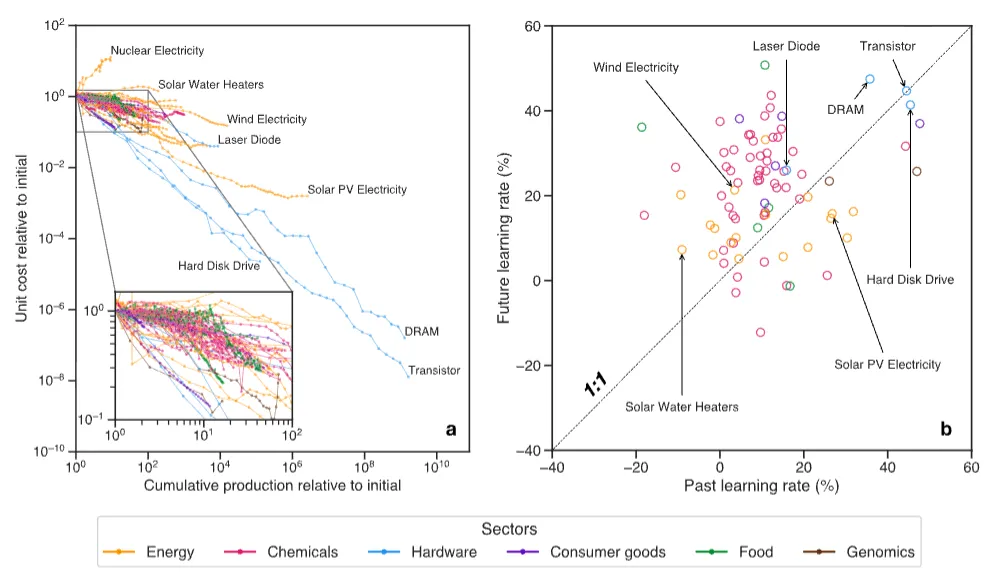
How fast things get cheaper. Lei and Alicia helped on this analysis questioning Wright’s law. Early technology learning rates aren’t good for predicting later ones, and in many cases a piecewise model does a better job of predicting future learning rates than simply assuming costs go down by a certain percentage with each doubling in production. Brian Potter also wrote a fantastic explainer here.
How much room different technologies have to improve. Aravindh helped with this exergy framework that connects a lot of things that otherwise might seem like separate observations. The biggest takeaway is that some technologies have a lot more room for improvement than others. Fuel, hydrogen, and ammonia production already run near thermodynamic limits. But things like dehumidification and food production could still get vastly better.
Even as technologies improve, overall cost structures stay similar. Learning rates tell you how fast costs fall, but not why they fall. Liem Dam-Quang notices that even when industries undergo big technical changes, their cost structures stay roughly the same. He looks at chip design, desalination, wind energy, and rocket launch and shows that they all keep roughly the same cost breakdown (between capex, energy, material, and labor inputs) even as the technology underneath changes completely. The takeaway is that if a new trick cuts the cost of one input in half, the winning move isn’t just to plop it into the old design. It’s to use more of the newly-cheap component and redesign everything around it until the cost structure looks familiar.
Take rocket launch for example. ULA at one point managed to calculate that reusing launch vehicles would save them at most 10%, and so they didn't work on it. SpaceX then pioneered rocket reuse, rebalanced their entire cost structure around it, and cut cost per launch in half.
An implication is that things only get cheaper when people are free to rebuild whole systems around technology improvements. When regulators or conservative customers lock an overall architecture in place, fundamental improvements can get wasted.
4) The nuclear options
Orca has mostly stayed away from nuclear stuff. I'm afraid of fusion for somewhat ‘Da Vinci’s helicopter’ reasons: like the flying machine in the 15th century, fusion energy is totally sound in principle, but it might be unbuildable with our early 21st century tech stack. And fission has too much baggage for a scrappy R&D group like ours: byzantine rules, high startup costs, the ‘paper reactor’ dynamic. IMO there are already lots of fission companies with workable reactors; we just need one of them to succeed enough for the whole thing to snowball.
But two Orca contributors have staked positions on fission stuff recently:
Rob Petroski argues that light water reactors are expensive because of their basic physics: high-pressure coolant and fuel that fails in accidents. That isn’t necessarily a reason to pivot to small modular or advanced reactors. The right design could still give you cheap power and passive safety.
Austin Vernon explains why fission is so hard to regulate and sketches two ways to rebuild nuclear regulation from scratch.
5) Food without agriculture updates
The idea of making food without farms is my pick for the most undervalued topic in all of energy and materials.
By "food without agriculture" I don't mean things like Impossible burger or Soylent or cell-based meats. Those are plant-based foods processed to mimic animal-based foods. I mean finding ways to chemically make food out of e.g. air and electricity.
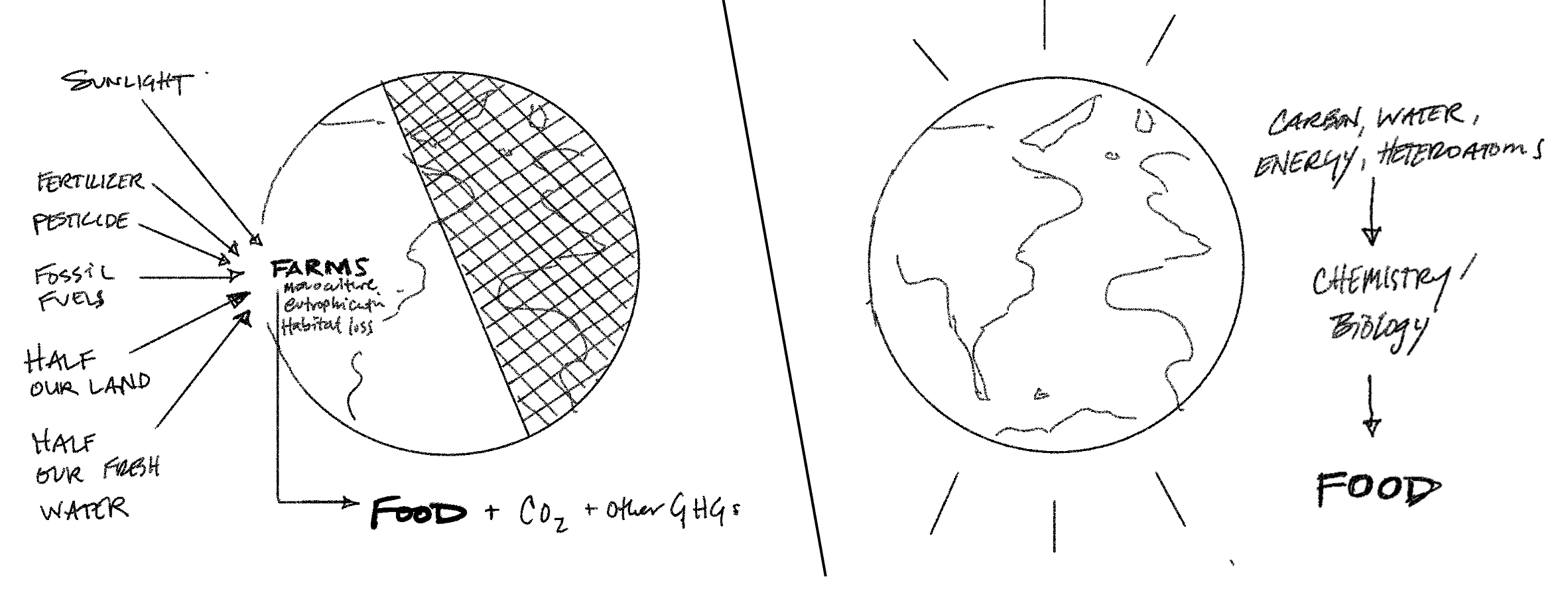
The dream is so big and touches so many things. Cheaper and better food without using so much land, water, fertilizer etc. A way for people to survive and thrive anywhere, in a blockaded Qatar or Taiwan, in a long drought, in outer space. Breaking the plot of all the disaster films like Interstellar or Pluribus[5]. Not killing so many animals. Saving the rainforest. Reclaiming continents' worth of land. Etc.
Anyways we have spent a lot of energy looking for ways to make macronutrients without traditional agriculture. New ways of synthesizing proteins. New ways to grow microbes on nonphotosynthetic feedstocks. Repurposing a paper mill to turn cellulose into starch etc. What have we learned?
Nothing else looks promising. Juan Garcia wrote a paper that summarizes most of the pathways we've considered. The takeaway is that despite years of looking, we have not found another idea like Savor. Nothing has the combo of giant addressable market, high priced beachhead markets, gimme technoeconomics, and food that is the real thing—not some new compound or pseudo food that people will have to get used to.
Outside of saturated fats, food compounds are complicated and incredibly heterogeneous. Most non-agricultural approaches look challenging, and unlikely to create anything palatable. Sadly but perhaps unsurprisingly, the other “food without agriculture” companies that got traction in the last decade are faltering or flatlining, Calysta and Circe and Arkeon just a few of note recently.
There's Savor, there's protein powders made from the desiccated carcasses of H2 /CH4 / MeOH oxidizing bacteria.... and not a lot else. It's too bad because if you put much stock in the long term survival of humanity this is really a capability we should have.
The one big hope. Savor is doing good. They're moving to the 300t/yr scale which will give positive gross margins, and hoping to build a first 10kta plant which is on the small side for scale economy but will still be profitable with their product mix. After launching in Michelin-starred restaurants last year they're coming down the market with products that will be in major low cost retailers next summer.
On the impact side, an independent life cycle analysis confirmed what they've been saying for years, namely that even the fats made from fossil carbon feedstocks are still vastly better for the earth than plant- or animal-based fats and oils. That's important because the CO2-based feedstocks that they need to use in order to make fats directly from CO2 and electricity are still in short supply.
6) Thoughts on chemical coproduction
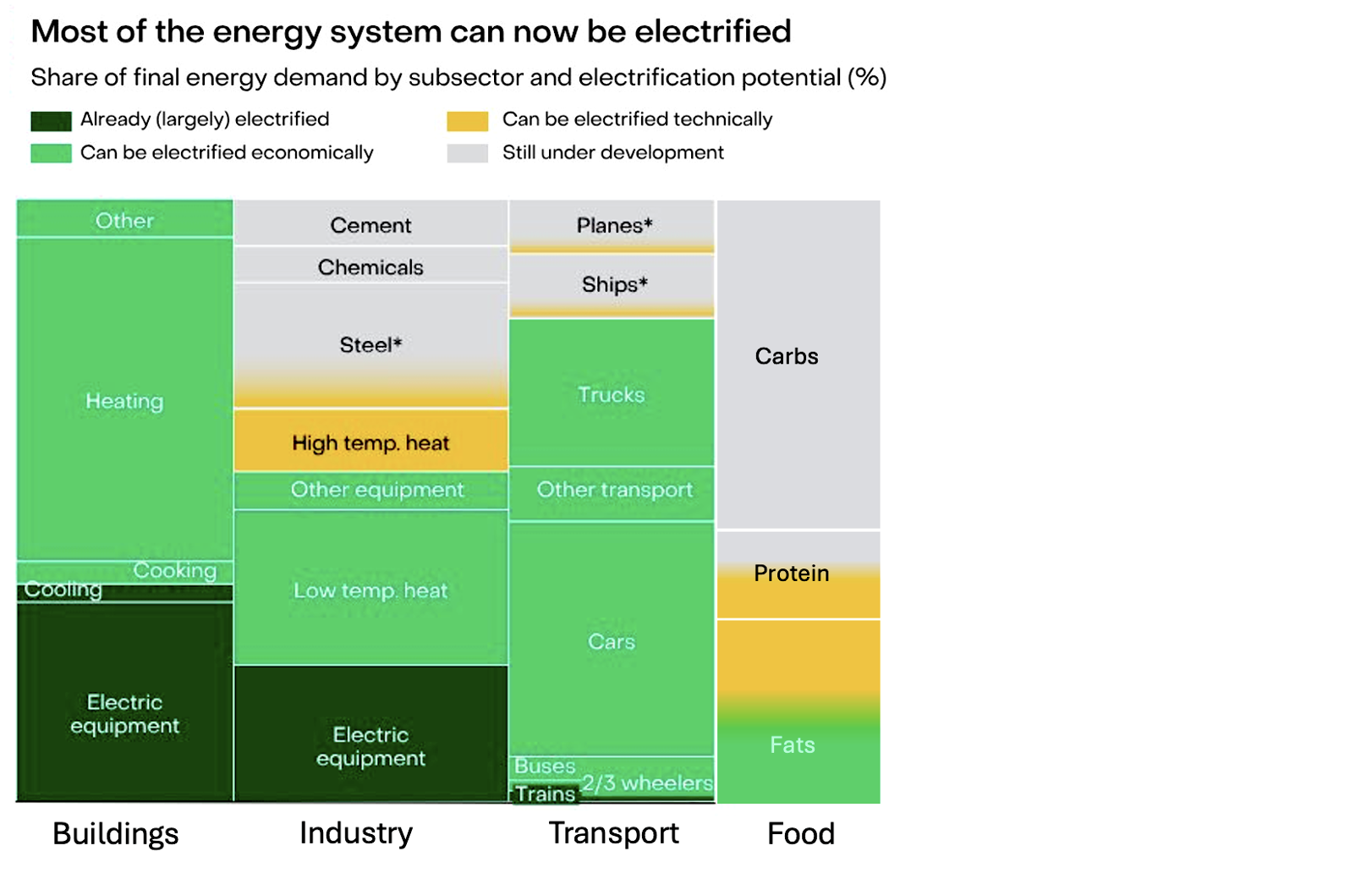
Electrifying commodity materials. Some of us helped with this paper on materials coproduction, spearheaded by Cody from Brimstone. We contend that it won't be possible to develop any single process that can cost-effectively decarbonize the big cheap commodities like e.g. cement or primary steel. Carbothermic production is too hard to beat. But there just might be a way to develop an electrified process that can make both of those at once.
At least this much is right: we can't just expect electricity prices to drop so far that we can electrify everything despite the big thermodynamic disadvantage of ditching fossil carbon. We gotta find actual advantages to electrification, like producing better materials, or (possibly) increasing revenue by making multiple products from a single source material.
Burning stuff in water instead of air. Here's a different approach. There are a few places in the economy where we currently burn things in air, but it’d be smarter to add a touch of energy and “burn” them in water. That gives us two products, the oxidized thing we wanted, plus hydrogen from the water. Two examples:
- S to SO4 — sulfuric acid is the world’s biggest commodity chemical. Right now, we get it by burning elemental sulfur in air and then combining it in water. But if we started the oxidation with water we could use the energy in the sulfur to liberate 1-3 mols of H2 per mol sulfur. That hydrogen could be super useful for making fertilizer, reducing metals from metal sulfides, and other stuff.
- NH3 to nitrate — Right now, we spend around 2% of world energy to reduce N2 to NH3 for fertilizer. But fertilizer factories then go backward and oxidize about a sixth of that nitrogen in air to make fertilizers like ammonium nitrate. The energy they get back from the oxidation comes out as heat. If we were smarter about it, we might oxidize the NH3 in water instead. Then we'd get the energy back in the form of hydrogen instead of heat—hydrogen we could use to make more NH3 and feed the cycle. This could give you a totally circular way to make nitrogen fertilizers without needing outside hydrogen at all.
Sam Faucher wrote a paper about a new way to do the sulfur one. It's a pretty cool twist on the Peregrine approach that uses thermochemical looping to oxidize sulfur in water without necessarily needing to electrify anything. There will probably be more on the nitrogen one soon.[6]
Footnotes
[1] What's the monetary value of a human life? You could say that the economy sets two different numbers. One is a self-interested number, how much people will pay to protect their own lives. That’s reflected in the economy in things like the wage premium for doing risky jobs, which gives a value of like $14M per human life in the US, closer to $2M globally. The other number might be an altruistic number. It reflects what people are actually willing to pay to save a stranger’s life. That’s like $2500, the amount that charities pay today to save a life in the global south.
So two prices. One in the millions to save your own life, another in the thousands to save a stranger's life.
These numbers come into play when people try to calculate the costs of climate change. Combining the price of a human life with predictions for climate-related mortality gives you a main piece of the widely-discussed “social cost of carbon”. The people in this field use the higher self-interested price of a human life, which leads them to calculate that the externalized cost of emitting a ton of carbon is on the order of $100.
But if you instead use the lower altruistic price of a human life, you would calculate a way smaller number for how much we should be willing to pay to prevent climate change. Scale down the University of Chicago social cost of carbon methodology for that number and you get <$5/tCO2.
Whose life are we saving when we prevent climate change? Not mine I think. Climate change will hurt poor people in hot places, so the right price on carbon should be based on the altruistic number--the number the world actually spends to save poor people in hot places. If it had turned out that contrail avoidance had an effective cost of $10/tCO2 equivalent, I would have said we shouldn’t do it. We'd be better off buying bednets for malaria or something.
This seems super obvious but many people have made the opposite decision. A few years ago the UK reduced its foreign aid budget (which had gone to a lot of high impact global health stuff like vaccines) and made big financial commitments to climate change stuff like the UN Loss and Damage fund or Climate Finance pledge.
In my opinion the climate change people stumbled badly by predicating fundamentally altruistic projects on carbon prices that reflect a self-interested willingness to pay. Obviously these are charity projects and so you should use the number that pertains to charity. My takeaway is that if someone builds a project with a green premium, then any durable subsidies should only go up to the altruistic price on carbon of ~$5/tCO2 or whatever more reliable number we can get. Otherwise those projects will siphon money off from much more deserving charity projects.
[2] Fermi estimates are my love language so let me share another. Ken Caldeira used the same $100M cost estimate but different reasoning and also concludes that contrail avoidance is about as effective as the best global health interventions:
- If contrail forcing is on the order 0.05 W/m2 to 0.10 W/m2, and each 1 W/m2 produces on the order 1 K equilibrium warming (probably a little less), then we would expect contrail avoidance to produce on the order of 0.05 to 0.10 K of cooling.
- If 2.5 K of warming adds 10 to 100 deaths per 100,000 per year and there are 10 billion people, that's 1 to 10 million people, or about 0.4 to 4 million per K.
- If we take the geometric mean of both numbers we get 0.07 K of warming and 1.3 million per K = 0.09 million per year, or around 100,000 people. So a central value of about $1000 per life.
An objection to this math from Juan Garcia is that climate change mortality is mostly old people, whereas global health stuff often saves the lives of children. So the $/DALY for contrails might still look worse.
If that ends up being true, or if operational costs end up being higher than expected, maybe we rely on the pareto distribution of contrail impacts. A tiny fraction of flights cause most of the warming, and some fraction of those can be rerouted with zero additional fuel cost. Instead of across-the-board contrail avoidance, you can probably be more selective with the flights you reroute to get costs back into a preferred range.
[3] The €240M number comes from page 62 here.
[4] This whole thing got me confused why copper is still so important to electrical transmission. Aluminum is cheaper per conductance and stronger per weight. And calcium is better than aluminum by most metrics, more conductive per mass, and it melts at a higher temperature. (Before you mention its reactivity consider that sodium conductors were once OK and it's easy to jacket calcium with other metals). Why do we need copper at all?
The biggest single answer is that low density is actually a problem in a lot of conductor applications. Low density means a nice light metal but also lower conductivity per volume. That complicates heat shedding in enclosed applications like underground cables. And in motor or transformer windings, higher volume wire makes the conduction path longer, increasing resistive losses even more.
A lot of this seems pretty engineerable. If copper supply is really so constrained, I’d expect to see heat-sunk light metal cables taking over underground like they have for overhead transmission.
High performance windings might be harder. As I see it the way to reduce copper demand in motors and transformers and increase performance at the same time is probably through better electrical steels, which have much more room to improve than conductors.
[5] We should be looking for more technologies that break the plots of disaster movies. The food one is great (Interstellar, Pluribus, the Matrix, Snowpiercer, Silent Running, No Blade of Grass, Soylent Green, Nausicaa, the Road…. ). But there will be others.
[6] Overall my prejudice is that coproduction gambits will be hard for the startups that try them. With two products there's twice as many moving parts that can break and kill you. BOGO may not be as compelling as giving customers the lowest price on the one thing they want most. And existing chemical plants that generate a lot of heat through an inefficient single-product process can get addicted to using that heat and might resist when you propose to take it away.